Reading MIT's AI Education Report with ChatGPT (Part Two)
If an excellent assignment no longer proves a student has learned, how should courses and assessment change?
In part one, we considered the overall argument of MIT’s report. Its deepest concern is not simply that students might cheat with AI, but that outsourcing cognitive work could also remove parts of learning that students once experienced for themselves.
This time we move into Section 3. ChatGPT reads it as MIT designing a new “operating system” for university education in the AI era. The first step is to ask: when a good assignment no longer proves that a student has learned, how should courses and assessment be designed?
The analysis below continues to preserve ChatGPT’s original approach.
I would not read Section 3 as a list of recommendations. Read it as MIT designing a new operating system for university education in the AI era.
MIT divides the section into three layers:
3.1 Change how we teach, learn, and assess → 3.2 Reaffirm people and community → 3.3 Build institutions capable of continuing to adapt.
Let us follow that logic.
3.1 Adapt educational processes for an AI-aware world

This is the most important part of Section 3. It begins by acknowledging a reality: AI can now do a respectable job on many MIT-level assignments completed outside class.
An old inference is therefore becoming unreliable:
The student handed in a good assignment ↓ The student has mastered the material
Problem sets, essays, take-home exams, and coding assignments used to do two jobs at once: practice for learning and evidence for assessment. AI separates those functions. A good submission no longer necessarily means the person submitting it can do the work. MIT therefore argues against merely building an “AI-proof wall” around old assessments; we have to reconsider what we are measuring.
3.1.1 Revisit course goals
This subsection asks a difficult question:
Now that AI exists, do students still need to master everything we used to demand of them?
Consider computer science. Students may once have been asked to write complex programs by hand. AI coding tools can now generate a great deal of code. So is “handwriting complex code” itself the educational goal, or was it a training method for something deeper?
If the real goals are understanding algorithms and systems, finding errors, designing architecture, and judging tradeoffs, the place of writing every line from scratch may change.
Be careful, though. MIT is not saying, “AI can code, so students need not learn to code.” It is saying: separate the learning outcome from the method used to complete a task.
Some established goals remain important and need new, AI-resilient ways to confirm that students have mastered them. AI may also make previously inaccessible learning goals possible: students can work with more complex texts, larger software systems, or more ambitious engineering objects.
Writing offers a similar example. Once AI can write an essay, “produce 2,000 words” may no longer be the ultimate goal. The real aim might be to develop a position → choose evidence → build an argument → consider counterexamples → revise the expression.
AI forces education to distinguish the task from the learning objective. To me, this is one of the central ideas of Section 3.1.
3.1.2 Durable learning: not everything should become a closed-book exam
MIT then anticipates a tempting response: if students can use AI on homework, increase the number of closed-book tests.
It is wary of this direction. The chain “AI can do homework → homework cannot be trusted → all grades come from timed exams” would create a strange system. Work outside university increasingly uses AI, reference materials, search, and collaboration. Yet to prove that students did something themselves, a university would require them to do it alone, without tools, in 45 minutes.
Is that testing the abilities we most want them to develop?
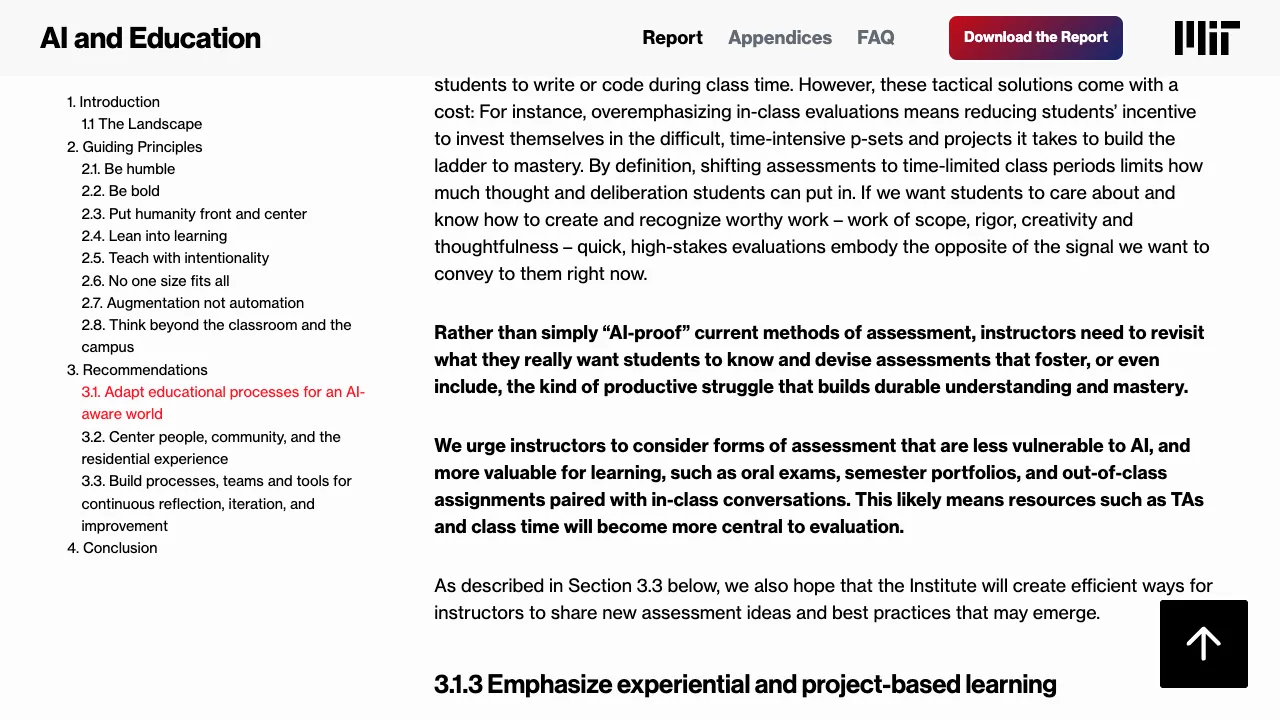
High-pressure, timed assessment limits time for careful thought. It may crowd out problem sets and projects that call for prolonged effort, creativity, and revision.
MIT points instead to oral exams, semester-long portfolios, and work completed outside class followed by live discussion in class. The point is not merely to ask, “Did you write this answer?” but:
Can you explain it? Why did you do it this way? What if I change a condition? Where did your approach fail?
Assessment might shift from verifying the product to verifying understanding.
Where productive struggle becomes concrete
This section returns to the productive struggle we discussed in part one.
MIT students are busy with demanding coursework and extracurricular activities. It is natural for them to seek efficiency, and AI is an exceptionally powerful efficiency tool. A reasonable student asks: “If AI can do this in five minutes, why should I spend two hours?”
But those two hours may be where learning happens. MIT calls this cognitive friction.
The resulting challenge is unusual: how do we design an environment in which an intelligent student with limited time still chooses a less efficient way of learning? It is one of the report’s deepest questions.
3.1.3 Experiential and project-based learning
One of MIT’s answers is to spend less time merely generating answers and more time making real things.
It is not opposed to AI. Quite the opposite: AI can make a project larger and more realistic.
The report gives software engineering as an example. A semester project once had to be a reduced version of a system because of the time available. With AI coding tools, students might build something approaching production quality in the same period. A course can then ask harder questions at a higher level:
Why this architecture? What happens when real users encounter it? What are the tradeoffs between designs? Where will the system fail in practice?
When AI lowers the barrier to execution, education can raise the level of the problem.
Architecture presents a similar possibility. AI can rapidly generate and test design proposals so students can explore a larger solution space. The report also stresses that foundational concepts, technical competence, judgment, and social reasoning become more, not less, important.
AI does not have to make a course easier. A well-designed course might become more demanding as AI becomes more capable.
3.1.4 An easily overlooked recommendation: more social learning
This is particularly interesting to me. MIT is not just worried that AI will make students unable to solve problems. It is worried that students will turn to people less often.
Previously, a student who was stuck might ask a classmate, go to a teaching assistant’s office hour, or join a study group. Now they ask ChatGPT. AI may offer excellent help, but the student loses another kind of practice: explaining an idea, listening to criticism, arguing, collaborating, admitting confusion, and judging whether someone else’s reasoning is sound.
MIT goes so far as to recommend a regular, structured, in-person social component in every course. This is not just sitting together in a lecture hall. It means interaction: solving problems in groups, project check-ins, peer feedback, and discussion.
The educational risk from AI is not only cognitive. It is also social.
If someone asks AI when studying, writing, debugging, and even feeling distressed, a university could become a group of people on the same campus, each talking to a machine. That is why the report returns to the purpose of residential education.
3.1.5 UROP: an especially important passage
MIT’s Undergraduate Research Opportunities Program, or UROP, is a signature part of its undergraduate research culture.
The report emphasizes that its primary purpose is educating students, not supplying professors with inexpensive research labor.
Why make that point now? AI agents may increasingly search literature, write code, clean data, perform preliminary analysis, and plan experiments. From a principal investigator’s narrow efficiency perspective, why mentor a novice undergraduate? An AI agent is fast, does not need to be taught, does not forget, and does not ask for a recommendation letter.
Under a logic of maximum productivity, undergraduates could lose badly. MIT’s point is that this is the wrong calculation.
In a laboratory, students learn much more than the task at hand: how research questions are formed, what to do with failure, how others critique work, how credit is allocated, how disagreements are handled, and how professional judgment develops in a field.
They gradually acquire an identity: “I am part of this research community.”
The report warns that replacing novice researchers with agents could take away not only research tasks, but a route into the research community itself.
In education, some seemingly inefficient relationships are the product.
3.1.6 MIT questions grades
This is one of the report’s more radical moments.
If an educational system rewards students for maximizing GPA, then using every permitted or gray-area method to raise GPA is rational. AI makes that incentive problem more obvious.
The committee even offers a thought experiment: if MIT had no grades, would much of the incentive for AI cheating disappear?
It does not recommend immediately abolishing GPA. It suggests seriously exploring competency-based assessment, mastery-based assessment, portfolios, and other approaches rather than assuming learning equals a number or letter grade.
Notice how the argument has moved from “cheating with ChatGPT” to “what behavior does the entire education system reward?” That is one of the report’s strengths.
3.1.8 The rationale matters more than the AI rule
MIT does not favor one AI policy for every course. Foundational mathematics, architecture studio, creative writing, and software engineering have different needs. Each course should, however, explain clearly how AI may be used—and why.
Do not simply say, “ChatGPT is prohibited.” Say: “The learning goal of this exercise is for you to build capability X yourself. AI would skip that cognitive step, so it cannot be used here.”
Conversely: “AI is permitted for this project because its learning goal includes verifying, integrating, and critically examining AI outputs.”
Students then see not merely a rule, but a learning contract. I find that much more useful than a bare “AI permitted” or “AI prohibited.”
3.1.9 Why MIT dislikes AI detectors
There are three layers to the reasoning.
First, AI use is often mixed. Someone may use it for brainstorming, a little rewriting, and some debugging. It is rarely a clean binary of human or machine.
Second, false positives can have serious consequences, including particular risks for students who are not native English speakers or who are neurodivergent.
Most importantly, detectors can turn a teacher–student relationship into police and suspect. Students reach for “humanizer” tools; schools buy better detectors; both enter an arms race that, in MIT’s view, serves no one.
The report prefers records of the process: version histories, intermediate check-ins, oral explanations, and staged submissions. Rather than trying to detect machine traces, make the learning process visible.
That is an important design principle.
3.1.10 AI Light and AI Heavy
MIT proposes an interesting experiment: courses might take two different routes.
AI Light deliberately limits AI to protect certain fundamental skills. AI Heavy makes extensive use of AI so students can learn to solve more complex problems in an AI-rich environment.
This is more useful than debating whether AI should be used at all. The real question is what role AI should play for this learning objective.
The report even calls for changing MIT’s slow curriculum-approval process. Multiple rounds of committee approval over more than a year may not keep pace with AI’s development.
Section 3.1 in one sequence
Previously:
Course content → homework → exam → grade.
In the education MIT is imagining:
Learning goals → which abilities must students master themselves? → which abilities can AI augment? → design productive struggle → projects, social learning, process evidence, and oral verification → demonstrate genuine mastery.
The point is not how to stop AI, but how to make learning visible again.
You can continue with the MIT report.
AI contribution
ChatGPT in the browser analyzed and interpreted the report. Biaoo assessed and selected its arguments, then shared those he found valuable. Codex translated the published Chinese article into English.