Why Widely Available AI Will Change Education as We Know It
The industrial model of education rests on scarce knowledge, comprehensive expertise, and individual self-sufficiency. AI is changing all three assumptions—and how human capability is valued.

Why should someone spend more than a decade in education?
Industrial society had a clear answer: to internalize the knowledge needed for future work and become capable of carrying out professional tasks independently.
Knowledge was divided into disciplines, and disciplines into courses. Students moved from foundations to advanced material, then took examinations to demonstrate that the knowledge had become their own. Schools thus prepared successive generations to enter the specialized division of labor as bearers of knowledge.
Three connected supports held this model in place: the scarcity of knowledge, the ideal of comprehensive expertise, and the goal of a self-sufficient individual.
AI is changing how knowledge is accessed, how cognitive work is divided, and how it is produced. Education can continue along its old path, but the people it prepares are entering a world that values their abilities by different rules.
Three supports of the industrial model of education
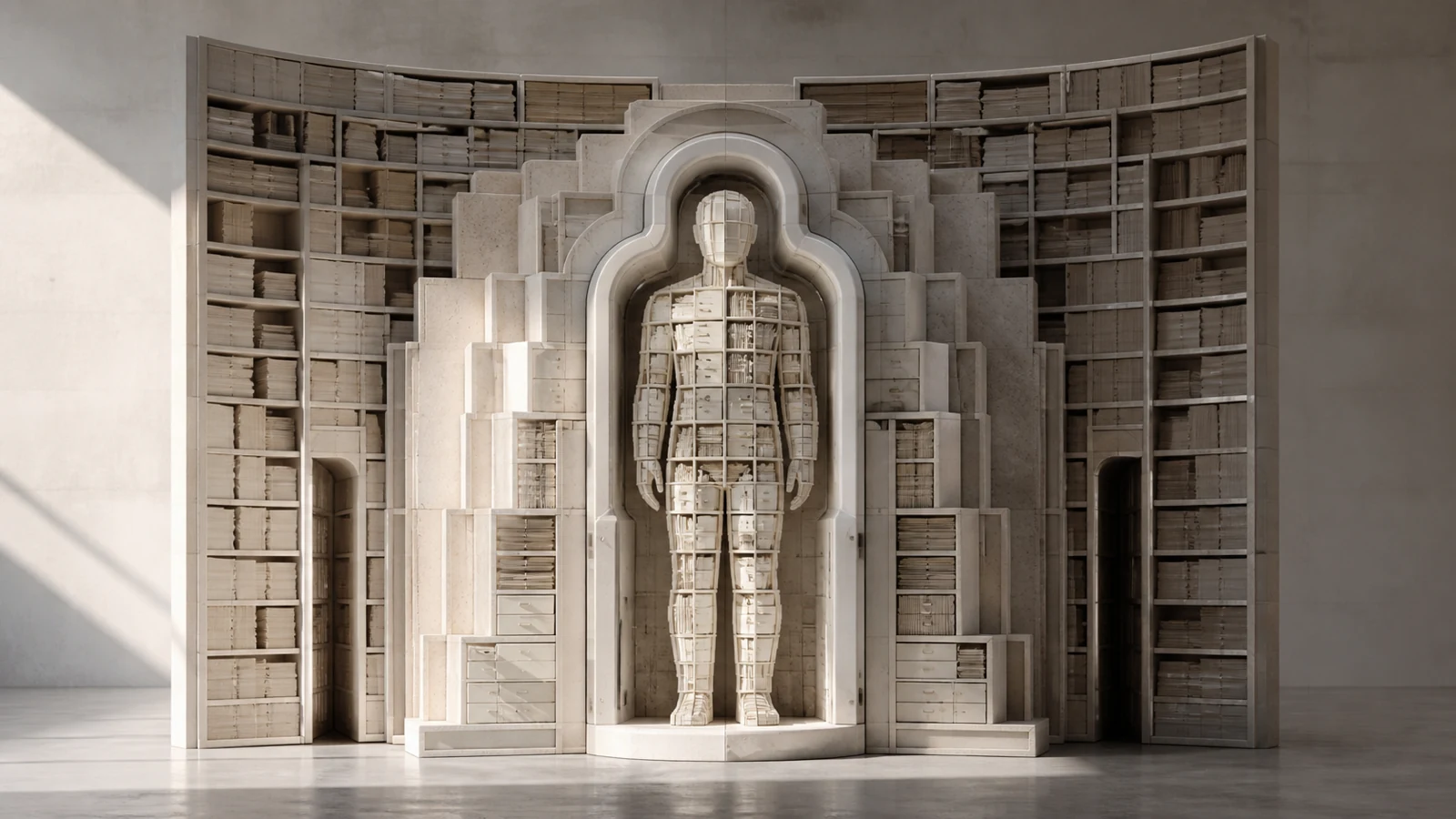
1. The scarcity of knowledge
In the industrial era, knowledge was a scarce resource.
The scarcity ran through every stage of its transmission. Books and materials had physical limits; access to schools and experts came with real barriers. Even when a source was in front of you, finding relevant information, understanding it, and connecting it to other knowledge took considerable time and sustained training.
Schools became the central mechanism for transmitting knowledge. They gathered scattered material into textbooks, divided large bodies of knowledge into courses, and had teachers pass them on in a prescribed sequence.
How much a person knew directly shaped the problems they could recognize and solve. Accumulated knowledge was both a capability and an asset.
2. Comprehensive expertise
If knowledge was scarce, a professional needed to master as much of their field as possible before entering work.
A discipline became a relatively complete body of knowledge. Students advanced layer by layer, from basic concepts and core theories to sophisticated applications. Earlier courses supported later ones; undergraduate work laid the foundation for professional training; graduate education took people further into a field.
The aim was comprehensive mastery: constructing an integrated professional knowledge base from foundations through theory to advanced practice.
The more knowledge someone held, the better equipped they were to handle complex problems and the greater the premium their expertise could command. Comprehensive mastery was a natural response to scarce knowledge.
3. The self-sufficient individual
Traditional education sought to produce an “independent bearer of knowledge”: someone able to work on their own within a relatively bounded profession.
To achieve that independence, knowledge had to be internalized. Without what the brain could recall, it could not be called upon immediately; without internal knowledge, the individual could not produce work independently.
These three supports pointed to the same kind of person: someone who had internalized a whole body of professional knowledge and could turn it into results on their own.
That was the knowing subject the model set out to form.
Within it, professional value followed a relatively simple logic of accumulation:
Professional value ≈ accumulated knowledge × years of experience
The more someone knew and the longer they had worked, the more valuable they became. The result was a familiar career path in which seniority was taken as a sign of capability.
Three changes AI brings

1. A radical increase in access to knowledge
The internet widened access to information. Generative AI crosses another threshold: the distance between finding material and understanding it.
A search engine used to return pages that people had to select, read, and piece together themselves. AI now participates directly in the cognitive work: explaining concepts, comparing views, translating terms, and adjusting the level of detail in response to questions. The initial processing that once demanded extensive specialist training is becoming an external service available on demand.
For the first time, what exists outside us is not only knowledge as stored material, but also an interactive capacity to help us understand it.
The bottleneck is shifting from finding knowledge to judging, applying, and creating it.
2. A new division of cognitive labor
AI is rapidly taking on many tasks involving procedural knowledge: retrieval, calculation, preliminary analysis, coding, and basic design. These are precisely the areas on which traditional education has spent so much time training people.
Work once performed continuously by one professional is being broken apart and redistributed between humans and AI. The profession may remain, while its internal division of cognitive labor changes.
The basic unit of cognitive work is shifting from the individual to the human–AI combination.
3. From individual production to system production
As the division of cognitive labor changes, so does the producer of knowledge.
We used to attribute capability to individuals: a physician knew medicine, an engineer could design a system, and a researcher could propose and test a theory. An organization’s capability was built from the separate expertise of many people.
Now what one person can accomplish increasingly depends on the larger cognitive system around them: their own domain experience, other people’s knowledge, databases, software tools, organizational resources, and AI all help shape the result.
A complex cognitive achievement can no longer be reduced to a skill held by one person alone. The isolated individual is yielding the central role in knowledge production to a connected system.
The moving frontier of AI capability

The industrial model promised a straightforward return: more knowledge and longer experience would bring greater value.
AI introduces a blunt new variable: where a capability stands in relation to the frontier of what AI can do.
That frontier is the boundary of cognitive tasks AI can reliably carry out at a given time. Once it encompasses a capability, what was a professional’s scarce asset can become a standard service available to anyone. Decades of experience accumulated around repeating that task can lose their scarcity remarkably quickly.
The same AI does not make everyone’s value converge. It can drive value further apart: abilities within the frontier become cheap services, while abilities beyond it may be amplified by AI.
Markets do not inherit anyone’s cost of learning. They pay for what can be produced now.
The frontier also keeps moving. An ability scarce yesterday may be standard AI capability today; experience that confers a professional advantage now may lose that scarcity tomorrow.
Knowledge and execution skills that a student spends more than a decade internalizing may become available as a $20-per-month standard service before that student has even graduated.
If the moving frontier absorbs much of the “crystallized intelligence” people acquire through long study and practice, education faces a hard question: what abilities must a person develop to retain their value in a new system of human–AI collaboration?
Translation: Codex prepared this English version from Biaoo’s published Chinese article. Biaoo developed the original argument and selected this essay for publication.