Reading MIT's AI Education Report with ChatGPT (Part One)
When AI can complete assignments and solve problems, what is the value of students learning for themselves?
Recently, I saw article after article discussing MIT’s new report, Report: MIT’s Ad Hoc Committee on AI Use in Teaching, Learning, and Research Training.
After reading more than a dozen, I still felt something was missing. They did not quite reach what I wanted to understand from the report.
My Codex allowance happened to be exhausted for a couple of days. While waiting for it to reset, I opened ChatGPT in the browser and asked it to guide me through a close reading.
As I had hoped, its interpretation was excellent. To my mind, it went further than the articles I had read.
I doubted that rewriting its analysis would improve it. More likely I would weaken its depth and force. So I decided to preserve as much of ChatGPT’s original analysis as possible and share it in that form.
The report is long, and so was our conversation. I will publish it in several parts. This is the first.
Do not begin by treating it as an “AI education policy document.” Treat it as MIT answering a larger question:
When AI can already do assignments, write code, solve problems, and draft papers, what is the value of a student learning for themselves? How should a university redesign education?
MIT’s Ad Hoc Committee on AI Use in Teaching, Learning, and Research Training wrote the report, which MIT released publicly on August 25, 2026. The committee had initially been asked to investigate AI use, teaching innovation, and policy. Its work led it to a larger question about the purpose of an MIT education itself.
First reading: what is the report actually worried about?

Many people hear “AI and education” and immediately ask whether students will use ChatGPT to cheat.
But in this report, cheating is only the surface issue.
The deeper concern is that AI can turn learning processes that once happened in a student’s mind into work that can be outsourced.
Consider an MIT student working on a problem set before AI:
They get stuck → consult a book → talk with classmates → go to office hours → try a solution → get it wrong → revise it → finally understand.
Learning often happens in the uncomfortable middle of that sequence.
The report repeatedly returns to productive struggle.
The greatest risk is not simply that AI will supply a wrong answer. On the contrary, it can supply a plausible-looking answer too easily. A student can move straight from:
Problem → AI → Answer.
There is an answer, but the cognitive path between the problem and understanding has vanished.
The report also discusses cognitive surrender: handing over the thinking to AI at the first sign of difficulty.
For me, the most important sentence for understanding the report is this: MIT is not trying to protect homework as such. It is trying to protect the human cognitive activity that takes place during learning.
What has MIT already observed?
The committee does not treat AI as a problem for the future. It is already changing campus life.
The report notes reduced use of office hours and online discussion. In anecdotes the committee heard, face-to-face study groups in dorms and libraries also seemed to be declining. Instructors find it harder to judge from work done outside class what students really know. Students use AI extensively while also worrying about becoming dependent on it.
One change is particularly striking:
Before: Encounter difficulty → ask another person.
Now: Encounter difficulty → ask AI.
AI is changing not just the efficiency of learning but a university’s social structure.
That helps explain the report’s emphasis on residential, face-to-face education. MIT’s value is not simply in teaching knowledge. It is also in solving problems with classmates, failing at experiments, arguing with professors, joining laboratories, and collaborating on projects.
Those encounters and frictions between people are themselves educational.
The second layer: eight guiding principles
MIT offers eight guiding principles. Put plainly, they are roughly these:
- Be humble. AI changes quickly; nobody knows exactly where it will lead. Policy has to remain revisable.
- Be bold. Do not merely patch the existing system by, for example, banning ChatGPT. Rethink the course itself.
- Put humanity front and center. Efficiency is not education’s only purpose. Some seemingly inefficient things, such as undergraduates doing research themselves, are precisely the point.
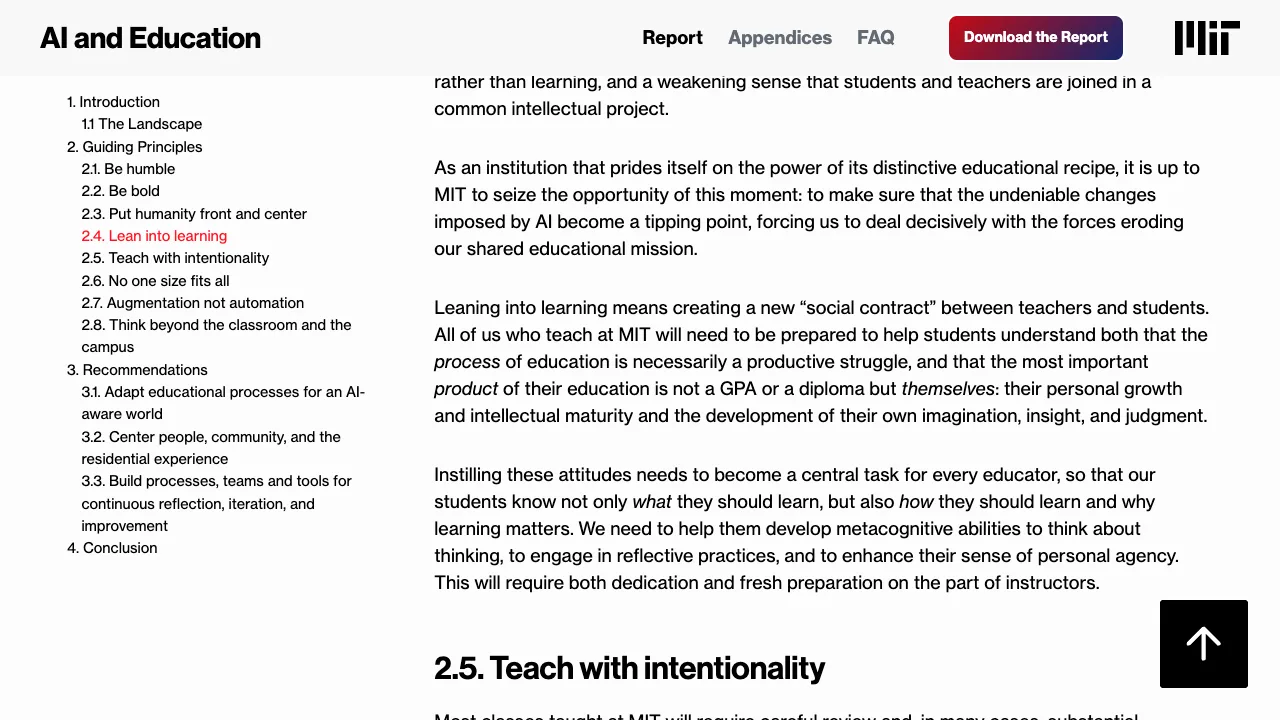
- Lean into learning. Ask not just what a student submitted, but what changed in the student’s mind.
- Teach with intentionality. Decide what students need to learn before deciding whether AI belongs in an activity.
- No one size fits all. The appropriate use of AI differs between poetry, mathematical proofs, architecture, and doctoral literature research.
- Augmentation, not automation. AI should enlarge human capability, not automate away the thinking students need to do.
- Think beyond classroom and campus. A university aims to develop people with judgment, the ability to cooperate, and a sense of responsibility—not just to help them pass courses.
The seventh is worth lingering over.
Augmentation is not automation
Consider learning to program.
Automation sounds like this:
“Write this program for me.”
AI does the cognitive work in the learner’s place.
Augmentation might sound like:
“Here is my design. Help me identify possible performance bottlenecks.”
Or:
“I wrote three approaches. Construct tests that might break them.”
The human retains responsibility for defining the problem → judging → deciding → verifying.
AI extends those capacities instead of replacing them. The report calls this pro-learner AI: technology that lets students take on problems they could not previously tackle, rather than reducing how much they learn.
The third layer: a more interesting response than banning AI
The report pushes back on the simple idea of making existing courses “AI-proof.”
If the reasoning is merely “ChatGPT can do homework, so everything must become a closed-book exam,” another problem appears. Students may be prevented from using AI improperly, but education may become more timed tests, fewer deep projects, and less creative exploration.
That is not the goal.
MIT’s direction is to redefine learning outcomes, then redesign assessment.
Future assessment could make greater use of oral examinations, long-term portfolios, records of a project’s development, classroom discussion, work completed outside class followed by an in-class defense, live experiments, and team projects.
Why? Because these approaches ask more than “Can you produce an answer?” They ask whether students understand it, can explain and judge it, can change it, and can apply it.
That may assess real capability more closely than traditional homework.
AI policies should explain why
MIT does not recommend one campus-wide rule saying “AI is forbidden” or “Use AI however you like.” It recommends that each course explain where AI can be used, where it cannot, and why.
For instance, if an assignment forbids AI, the explanation should not simply be “AI equals cheating.” It should say: this exercise is designed to help you build a particular foundational capability yourself. If AI does that step, you miss the training.
The reverse applies when AI is allowed: why is using it part of the learning objective here?
This treats students as people capable of judgment, not simply as people who need monitoring.
The report also warns against excessive reliance on AI detectors. False accusations, ways around detection, and an arms race in which teachers catch and students evade one another can damage trust.
The report’s deepest question may not be about AI
Remove every mention of AI, and the report also reads as a critique of a pre-existing problem in modern higher education: students increasingly understand learning as completing tasks.
Assignment → grade → GPA → degree → job.
The rational strategy becomes optimizing how efficiently those tasks get done. AI pushes that logic to its limit. If the goal is only to hand in a correct answer, of course AI is attractive: it is faster.
The report therefore asks a fundamental question: what is the product of education?
Not the assignment. Not the grade. Not even the diploma.
The student.
Your judgment, imagination, problem-solving ability, persistence, capacity to work with others, and ability to think independently about unfamiliar problems.
The report makes the point explicitly: students need to recognize that the most important product of their education is not a GPA or diploma but themselves—their growth, maturity of mind, and developing imagination, insight, and judgment.
This is where I would stop for five minutes and think.
A tension the report does not resolve
MIT says both “Do not let AI replace human thought” and “Students must learn to use AI well.” At first that sounds contradictory.
It is trying to draw one of the hardest boundaries in future education: which cognitive abilities must live in your own mind, and which can reasonably be delegated to a machine?
After calculators, we accepted that complex arithmetic could be delegated, while still asking students to understand numbers, equations, and quantitative relationships.
After AI, what about coding? Writing? Researching sources? Mathematical proof? Constructing an argument? Designing an experiment? Posing a question?
The report does not—and cannot, once and for all—settle that boundary. Hence its call for AI-aware education, rather than a simple “AI education.” Each field has to ask again:
Once AI exists, what must a person who truly understands this discipline still carry in their own mind?
Three concepts to take away
1. Productive struggle. Learning needs a degree of difficulty, trial and error, and cognitive friction.
2. Augmentation over automation. Let AI extend what you can do, rather than do in your place the thinking through which you would develop an ability.
3. AI-aware learning. Neither pretend AI does not exist nor assume it belongs everywhere. Define what people must learn first, then decide where AI enters.
Those three ideas will help make sense of much of the remaining report.
There is another telling figure. MIT students do not simply want unrestricted AI use. In the report’s fall 2025 Tech Survey, more than two-thirds of respondents thought AI would matter to their future careers, but only 25 percent felt MIT had prepared them adequately to use it. Their request is closer to “teach me to use it well” than “let me use it without limits.”
You can continue reading the MIT report itself.
Further reading
- Why Widely Available AI Will Change Education as We Know It
- A Thought Experiment: What Should We Learn If AI Can Do Everything?
AI contribution
ChatGPT in the browser analyzed and interpreted the report. Biaoo assessed and selected its arguments, then shared those he found valuable. Codex translated the published Chinese article into English.