AI and Education: Which Historical Transformations Offer Useful Parallels?
Writing, printing, calculators, school systems, and MOOCs offer ways to understand how AI may change learning—and where historical analogies reach their limits.
In this essay
- I. Which historical transformations offer meaningful comparisons?
- II. What, then, is new about AI?
- III. Research already shows that helping someone get an answer right is different from helping them learn
- IV. How does education need to adjust?
- V. Where does historical experience stop being useful? What still applies, and what cannot be carried over?
Are there comparable historical transformations that can help us understand AI’s impact on education today? Or is this an unprecedented disruption? What does history suggest about education’s future in the age of AI? Have traditional historical lessons become entirely irrelevant in the face of this technological wave?
I. Which historical transformations offer meaningful comparisons?
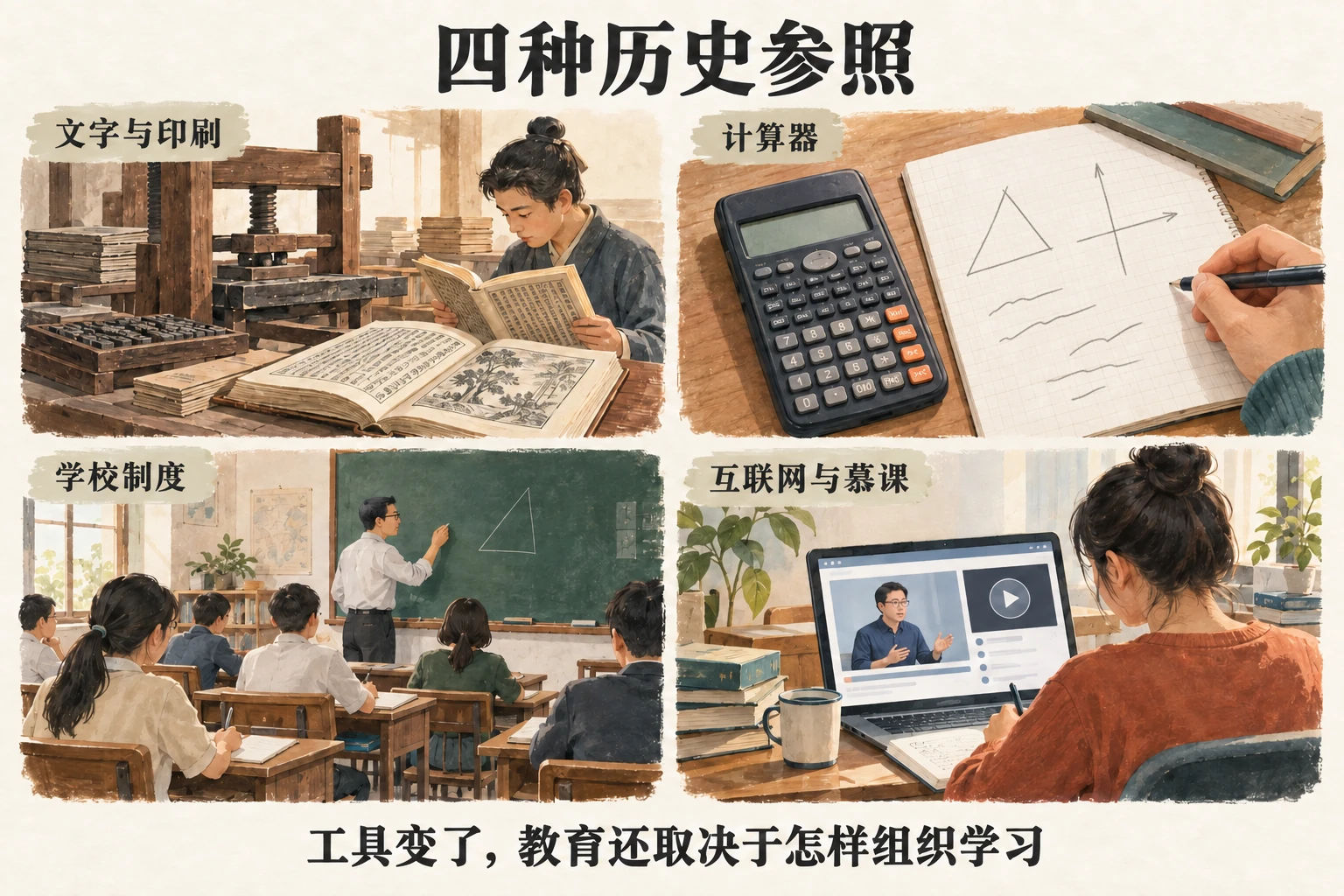
1. Writing and printing: knowledge can be stored externally, but understanding does not follow automatically
In Plato’s Phaedrus, Socrates tells a story expressing concern about writing: reliance on external records may weaken memory, while exposure to large amounts of written material may give people the appearance of wisdom without genuine understanding. This resembles today’s concern that students may rely on AI and mistake fluent answers for their own ability [1].
We cannot simply dismiss these concerns as ancient overreaction. A technology can increase society’s overall capacity for knowledge while some individual skills deteriorate. The more useful comparison asks how cognitive abilities are redistributed and combined between people and tools, rather than whether technology is wholly good or wholly bad.
Research on Europe’s early printing industry offers another lesson. Printing reduced the cost of spreading ideas, but also attracted schools, students, and translators. Printing workshops even encouraged face-to-face exchange among scholars, merchants, and artisans [2].
Better long-distance communication does not necessarily eliminate in-person exchange. It can create new reasons for it.
For AI, the lesson is that cheaper, more accessible educational content is not enough to conclude that schools and teachers will disappear. Once knowledge becomes easier to obtain, the more consequential question is how to reorganize understanding, discussion, feedback, assessment, and shared life.
The analogy has a clear limit, however. Books mainly preserve and transmit existing human expression. Generative AI can participate in producing expression and, through ongoing dialogue, influence the learner’s next steps in thinking.
2. Calculators: which operations to outsource, and which understanding to retain
Calculators offer the closest parallel to today’s debate about whether basic skills still need practice. A 2003 meta-analysis of 54 studies found that integrating calculators into instruction and assessment could improve students’ computational and problem-solving performance. Results on assessments that prohibited calculators were more complicated. The authors also noted that long-term retention and transfer across domains required further study [3].
The calculator experience shows that a tool’s educational effects depend on instructional arrangements and how it is used.
In learning statistics, for example, removing tedious hand calculations can help learners focus on variables, distributions, errors, and the conditions under which a method applies. Saving mechanical work can support deeper understanding. Without a conceptual foundation, however, it may simply let someone obtain an answer they do not understand more quickly.
AI goes a step further. It may do more than calculate: it can choose methods, organize arguments, and explain conclusions. The old division of labor—leave computation to the tool while retaining conceptual understanding—now needs redesigning, because the tool can also generate conceptual explanations.
3. Modern school systems and institutional change: tools are not the only things that change education
Education’s history cannot be reduced to a succession of equipment: blackboards, radio, television, computers, AI.
Education historians David Tyack and William Tobin used the concept of the “grammar of schooling” to examine why institutions such as age-graded classes, credits, and scheduled instruction persist, and why many reforms are ultimately pushed to the margins. They emphasized political and institutional explanations for educational continuity and change [4].
China’s modern institutional transition offers another comparison. The imperial civil service examinations were abolished in 1905, while the organization and aims of new schools changed around the same time. Nanyang Public School, for example, became the Shanghai Higher Industrial School under the Ministry of Commerce. Its programs were related to industrial and commercial needs, demand for technical personnel, and sources of funding [5].
What changed was more than what students could read. It also included which forms of knowledge opened the way to careers and social recognition.
This is an institutional precedent rather than a technological precedent for AI. It reminds us that the depth of educational transformation depends on whether admissions, examinations, credentials, employment, and resource allocation change alongside it. If admissions systems continue to reward the same standardized examination performance, advanced AI may become a more efficient exam preparation tool without automatically producing inquiry-based learning. Technology does not choose educational goals by itself.
4. The internet and MOOCs: open resources do not automatically produce educational equity
Massive open online courses once carried hopes of opening high-quality education to very large populations. In a 2019 study published in Science, Justin Reich and José Ruipérez-Valiente analyzed six years of Harvard and MIT edX data. They found that participation growth was concentrated in wealthy countries and that completion rates had not clearly improved over time. The platforms were turning toward university partnerships offering career-oriented online degrees. These findings do not invalidate all online education, and completion is not the only measure of learning value [6].
The study suggests that putting courses online partly answers “Where are the resources?” It does not necessarily answer “Who has time to study, who can persist, and who receives help?”
Generative AI’s interaction and feedback may address some of MOOCs’ shortcomings. We still cannot infer that everyone receives an equally good education merely because everyone can open a chat window.
The shared lesson of these comparisons is that technology expands what is possible, while institutions and instructional design determine which possibilities are realized.
II. What, then, is new about AI?
AI’s novelty is not that people are using external cognitive tools for the first time, nor that automated tutoring systems have just appeared. The OECD’s Digital Education Outlook 2026 identifies the crucial changes as generative AI’s general-purpose capabilities, natural-language interaction, and extensive use outside schools’ direct control. It may also make previously more rigid digital tutoring systems more flexible in how they ask questions, offer hints, and adjust strategies [7].
Three changes deserve particular attention.
First, AI may intervene in many stages of learning at once, rather than in a single step.
It can assist with reading a problem, choosing an approach, reasoning, calculating, explaining, and revising. In writing, it can help develop an idea, organize sources, construct an argument, and polish expression. The educational question is then no longer simply whether looking things up is faster. It is which cognitive activities the learner personally performs across the process. Not every step must be done manually, but schools must distinguish between cultivating a student’s abilities and merely producing a result.
Second, AI makes the relationship between the quality of a work and its author’s ability less certain.
Suppose a student submits a fluent, well-structured essay. Once generative tools are involved, the finished work alone makes it harder to tell whether the student understands its concepts, can identify counterexamples, or knows where the evidence came from.
This goes beyond managing cheating. It is a problem of assessment: when tools can generate the appearance of ability, education must find new evidence of ability.
Third, AI may change the work and development paths that education prepares people for, while also changing learning itself.
One risk deserves examination in advance. If AI increasingly handles entry-level writing, basic programming, and routine data analysis, the traditional path of becoming an expert by gradually gaining experience through basic work may weaken in some professions. This does not prove that those jobs will disappear. It raises a practical question: if organizations focus only on immediate output efficiency, who will bear the long-term cost of developing the next generation of experts?
The question runs deeper than whether students may use AI for homework. It concerns how society develops future professionals.
III. Research already shows that helping someone get an answer right is different from helping them learn
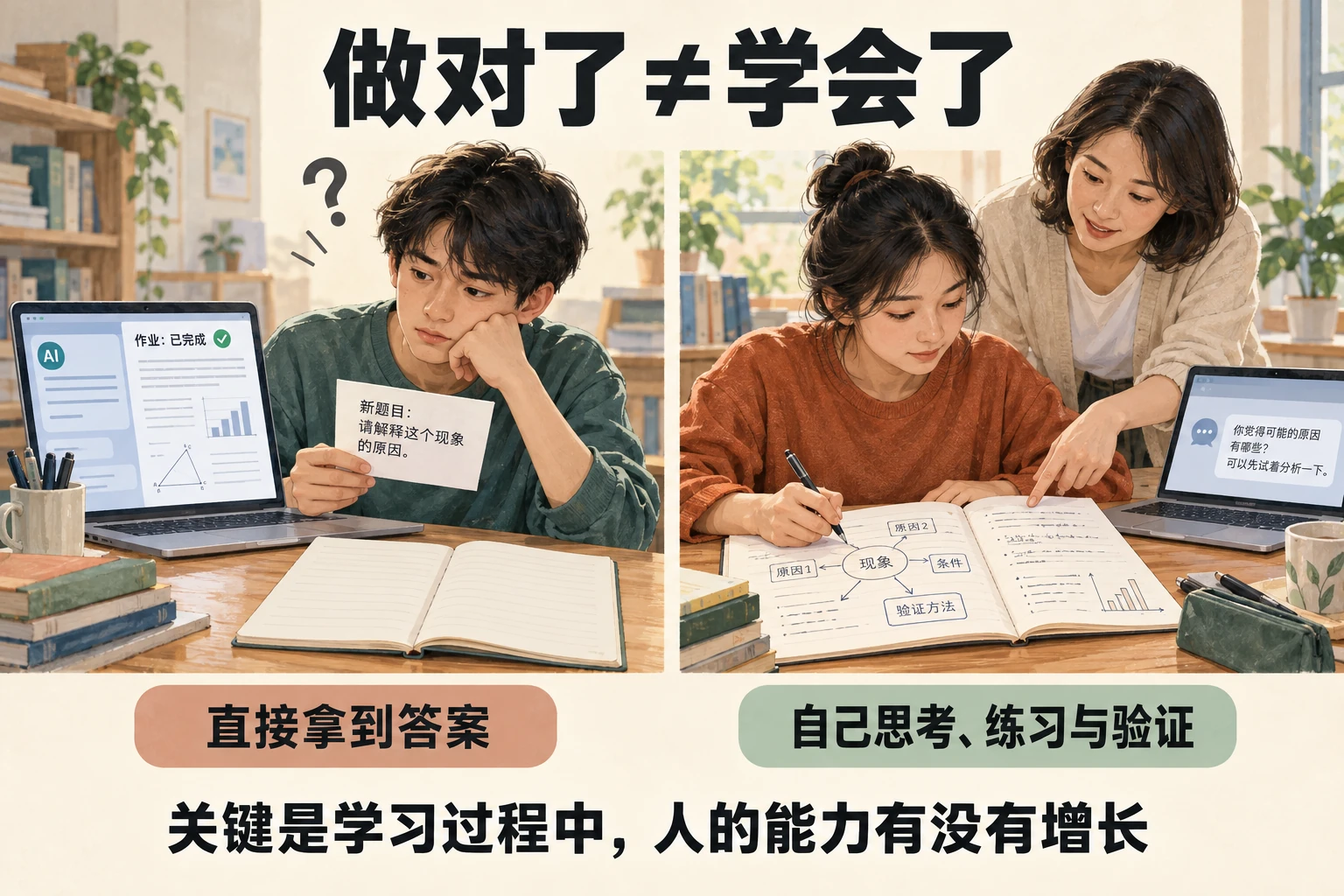
Some of the most useful evidence comes from experiments with different outcomes that reveal the importance of conditions of use.
A randomized trial published in PNAS in 2025 involved nearly 1,000 mathematics students at a high school in Turkey. Students using a conventional conversational AI performed about 48% better than the control group during practice. But when AI was removed, their independent test performance was about 17% lower. Teacher-designed prompts and learning safeguards largely eliminated the negative effect, although that group did not significantly outperform the control group on the independent test [8].
Another randomized trial, published in Scientific Reports in 2025, compared specially designed AI tutoring with in-class active learning in a Harvard physics course. Among the 194 students included in the analysis, those using AI tutoring achieved larger immediate learning gains in two specific lessons and spent less time. The researchers emphasized that the system included expert-designed materials, prompts, and instructional support. The results therefore do not establish that AI is superior in every learning situation [9].
These results are not contradictory. The experiments compared concrete uses involving different learners, content, and instructional arrangements, rather than an abstract choice between having AI and not having it. Neither short-term experiment can directly answer how abilities will change over many years.
Together, they raise a central question:
Does AI increase students’ productive thinking, practice, and feedback, or help them bypass those processes?
Education differs from ordinary production here. Production usually seeks a satisfactory product more quickly. Education must also ask what happens to a person’s abilities after completing the activity. Greater learning efficiency should mean developing one’s own abilities more effectively, rather than simply submitting a result faster.
IV. How does education need to adjust?
Drawing on historical experience and the mechanisms above, we can examine the pressures on education and possible responses worth exploring.
1. Curricula need to reconsider the foundations, rather than declare foundational knowledge obsolete
“Since AI can answer questions about knowledge, all we need to teach is questioning and critical thinking” wrongly separates knowledge from thought.
The U.S. National Academies’ How People Learn II explains that prior knowledge can reduce demands on attention and support new learning. Building knowledge structures and using knowledge to reason are intertwined processes. Prior knowledge can also create biases, which require active correction [10].
Without subject knowledge, it is difficult to judge reliably whether an answer omits conditions, confuses concepts, or misuses sources. Detached from a concrete knowledge base, “asking good questions” often remains an empty aspiration.
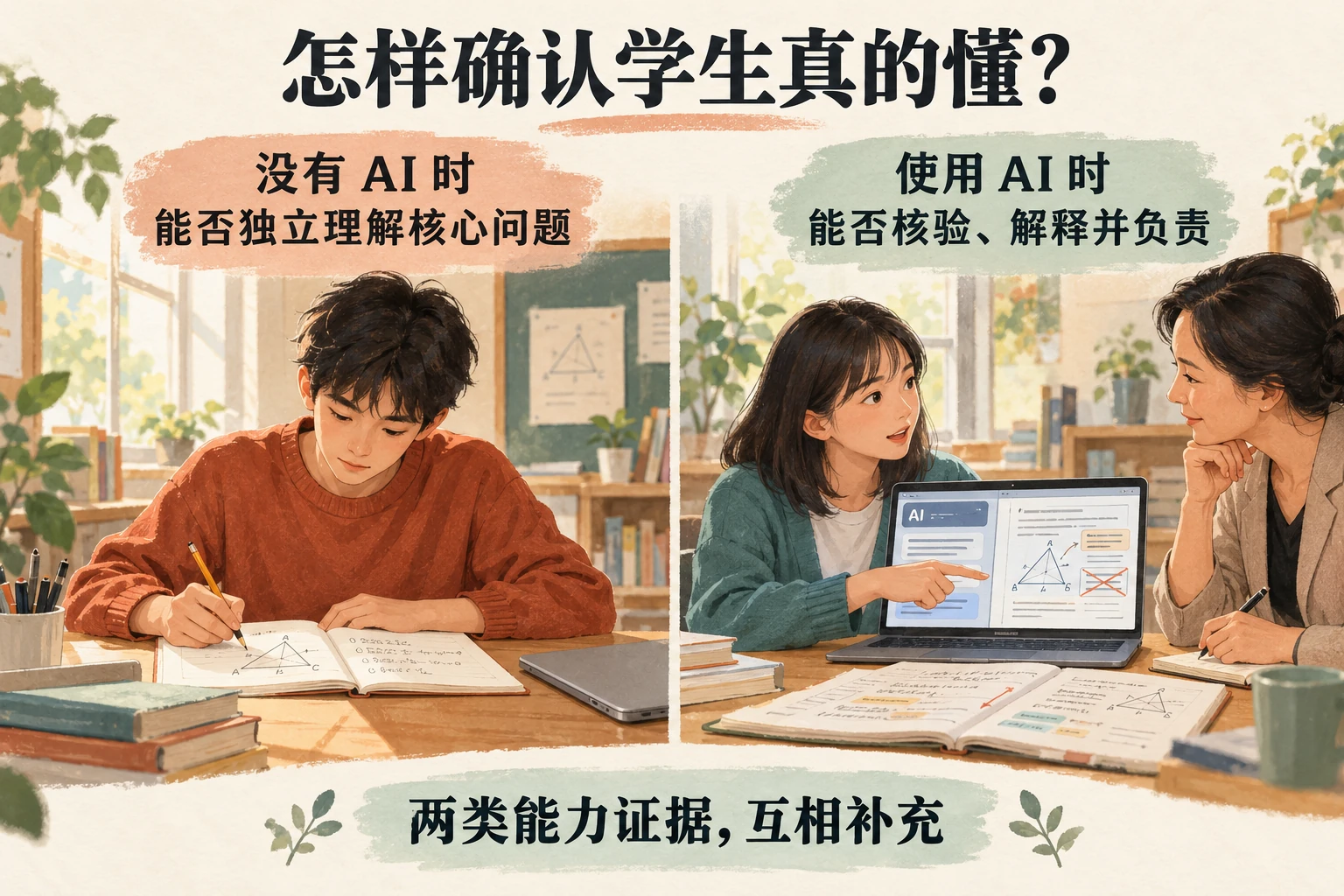
A more reasonable goal combines three abilities: independently understanding core problems, using tools to expand the range of problems one can solve, and checking and taking responsibility for the results.
That does not mean preserving every old exercise. The foundations themselves need review: retain knowledge that supports understanding, transfer, and judgment, while reducing tedious mechanical work that was necessary only because earlier tools were limited.
Children, beginners, and experienced professionals also need different arrangements for tool use. Education should protect necessary thinking processes without romanticizing every difficulty as beneficial struggle.
2. Assessment faces direct pressure, but does not have to retreat to fully closed examinations
One direction worth exploring combines two kinds of evidence.
The first establishes which core concepts and basic skills a student has mastered under appropriately controlled conditions without AI answering for them.
The second uses authentic tasks that permit AI and evaluates how students frame questions, select evidence, verify results, and handle uncertainty.
A research assignment, for example, could allow AI while requiring students to explain the basis of their key judgments. In a short oral defense, they might answer: Why use this method? Which suggestions were rejected or changed? Would the conclusion still hold under a different condition?
These forms of evidence should complement each other, with fairness and accessibility considered. Process records are not perfectly reliable. Turning every assessment into an oral examination or high-pressure live test is not a suitable answer either, and the approach need not entail ever more surveillance. Valuable assessment should focus on what students actually understand and can do, rather than only on the provenance of text.
3. Teachers’ mix of tasks will change, but staffing cannot be inferred from technical capability alone
“AI can explain problems, so teachers will be replaced” and “Teachers have human warmth, so they can never be replaced” both oversimplify complex institutional mechanisms.
An approach worth watching is using AI to assist teachers or tutors rather than bypass them. A randomized trial preprint on Tutor CoPilot involved approximately 900 tutors and 1,800 students. When tutors received real-time AI suggestions, students’ probability of meeting topic mastery criteria increased by about four percentage points. Students of previously lower-rated tutors benefited more [11].
This suggests that technology may expand access to effective teaching methods, rather than merely replace teaching labor.
Whether the time saved goes toward individual tutoring, course design, and student support, or toward larger classes and staffing cuts, is not something model capability itself determines. Teachers will face pressure to reorganize their work; the outcome depends on how educational systems use the efficiency gains.
We also need not rest education’s meaning on the assumption that there is some ability machines will never possess. Even as machines become more capable, society must still decide who sets educational goals, who takes responsibility for students’ development, and who answers questions about those decisions.
4. Schools, classrooms, and credentials are more likely to diverge than disappear together
If explanations and individual feedback become easier to obtain, schools do need to demonstrate anew the value of collective learning, practical activities, peer relationships, and credible assessment. That does not mean every school can successfully transform, or that all education should return to campus.
One organizational form worth pursuing lets individual practice and collective learning complement each other: students receive help at their own pace in some stages, then discuss, collaborate, and verify in classrooms, laboratories, and real projects.
Credentials are pulled by two opposing forces. If employers can verify ability directly more easily, some credentials may lose value. If impressive-looking work becomes easier to generate, however, credible and rigorous certification of ability may become more valuable.
“AI can teach a great deal” therefore does not establish that university credentials will inevitably lose their meaning. Teaching, selection, and certification are different social functions, and technology may affect them in opposing directions.
5. How to use efficiency gains, and how to verify educational quality
Lower technological costs can improve education and widen access to good resources. The crucial questions are where the saved resources go and whether educational quality has actually been verified.
Three paths could coexist:
| Path | Main use of AI | Possible outcome |
|---|---|---|
| Better teaching | Help teachers identify difficulties and provide detailed feedback; use saved time for student support | More people receive targeted, high-quality tutoring |
| Low-cost substitution | Primarily replace existing staff and services through automation, with little quality verification | Broader apparent coverage, but inadequate support and feedback |
| More intensive exam preparation | Provide denser, more precise training around existing selection criteria | Learning efficiency may rise without changing the structure of competition |
Educational quality must be judged by the learning support actually provided. Neither the technology deployed nor the proportion of human involvement is enough to establish quality on its own. Disadvantaged students also need effective support; they should not be presumed to deserve only an unverified, inexpensive alternative.
Another practical distinction is easily overlooked: teaching everyone better and getting everyone into a limited number of elite institutions are two different problems. AI can improve individuals’ absolute abilities, but greater efficiency alone cannot remove competition created by relative rankings and scarce opportunities.
Educational equity therefore involves more than devices and accounts. It also involves teaching support, available time, credible assessment, and platforms’ influence over student data and judgment. UNESCO’s guidance on generative AI in education likewise identifies privacy, age appropriateness, human agency, and reviews of educational and ethical validity as important principles [12].
V. Where does historical experience stop being useful? What still applies, and what cannot be carried over?
When examining history in the face of AI, we need to distinguish historical conclusions from historical mechanisms.
Specific conclusions cannot simply be carried over. That past technologies eventually created new occupations does not guarantee that every displaced ability will readily find a new place this time. That universities adapted to printing and the internet does not guarantee that every kind of university can adapt to AI. That some earlier technological fears were exaggerated does not prove today’s risks of dependency are unreal. Overall social benefit does not mean students, teachers, and workers face no real costs during the transition.
Questions about mechanisms remain useful. Which costs does technology reduce? Where does it move scarcity? Who controls tools and standards? What behavior do schools reward? Which groups can turn tools into abilities? These questions do not become irrelevant simply because technology becomes stronger.
Generative AI’s long-term effects still require long-term tracking, experiments across contexts, and ongoing correction. Historical analogies can help formulate hypotheses, but cannot replace direct evidence about today’s technology.
At a deeper level, suppose future AI substantially outperforms humans in most cognitive tasks. This should be considered a conditional scenario rather than an established fact. Under that condition, understanding education mainly as training people to do what machines do poorly would face a fundamental challenge.
But machines doing something better than people does not mean people no longer have reasons to learn. People may learn to understand their own circumstances, participate in public decisions, appreciate and create culture, and build relationships with others, rather than only to beat machines in a contest of output. What then needs reconsideration is education’s purpose and resource allocation, rather than instructional technology alone.
Changes in education in the age of AI must therefore be understood through the reorganization of abilities, assessment, and institutions.
Technology can complete a learning task for someone, but completing the task does not automatically mean that person has grown.
What needs protecting is everyone’s opportunity to develop understanding, judgment, the ability to act, and the capacity to live with others. History can still help us see those conditions, so that we do not mistake technological possibilities for education’s inevitable fate.
Sources
[1] Plato: Phaedrus, Internet Classics Archive
[2] Information technology and economic change: The impact of the printing press, CEPR
[4] The “Grammar” of Schooling: Why Has it Been so Hard to Change? David Tyack and William Tobin, 1994
[5] The abolition of imperial examinations and Nanyang’s practical education, Xi’an Jiaotong University
[6] The MOOC pivot
[7] OECD Digital Education Outlook 2026
[8] Generative AI without guardrails can harm learning: Evidence from high school mathematics
[10] How People Learn II: Learners, Contexts, and Cultures, Chapter 7
[11] Tutor CoPilot: A Human-AI Approach for Scaling Real-Time Expertise
[12] Guidance for generative AI in education and research, UNESCO
AI contribution
This article grew out of a conversation between the author and AI. AI helped develop the historical comparisons, organize research leads, draft and edit the text, and create illustrations. The author posed the original question, selected the article’s direction and title, and made the editorial and final publication decisions. AI translated the Chinese article into English for the blog, with the author responsible for publication decisions.