Reading MIT's AI Education Report with ChatGPT (Part Three)
If AI can provide information and help at any time, why come to a university to live and learn with other people?

In this essay
The previous article discussed how AI makes assignments less reliable as evidence of learning, while also making students less likely to turn to another person when they encounter difficulties.
In Section 3.2, MIT asks about the deeper consequences: if information, explanations, and help are always available from AI, why come to a university to live and learn with other people?
What follows continues ChatGPT’s analysis, translated from the Chinese conversation.
3.2 Center people, community, and the residential experience

If Section 3.1 is about redesigning courses, Section 3.2 is about answering again why we go to university.
There is something philosophical about this section.
MIT says that AI is arriving at a time when the social fabric of American universities is already fragile. Loneliness, disconnection, the rebuilding of in-person communities after the pandemic, and strained campus relationships were already problems.
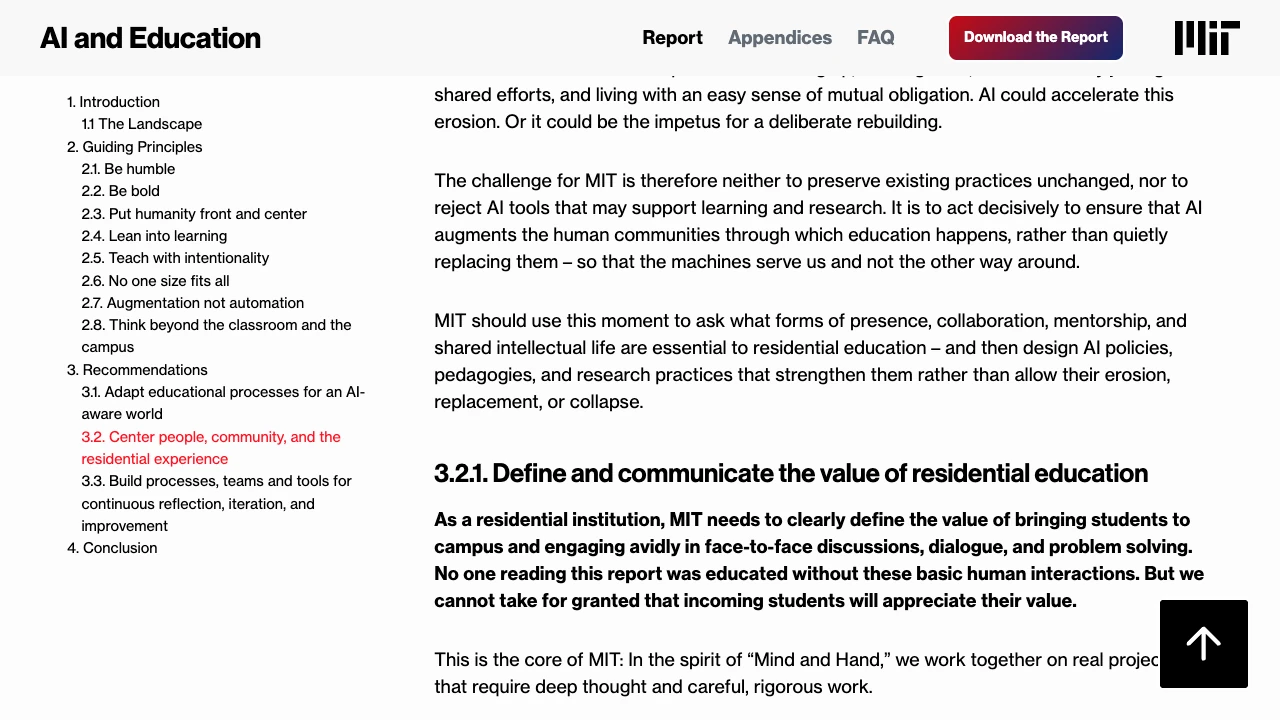
AI may accelerate individualization. Everyone gets a highly personalized tutor, assistant, or adviser. That looks excellent from the perspective of efficiency, but the community may grow weaker.
MIT therefore makes a clear case for residential education. You do not come to MIT simply to obtain information; there is already plenty of that online. You come to do difficult things together with other people.
The report describes learning as effective because it is both challenging and social. I find that a beautiful formulation.
3.2.2 Even “Tech Free Times”
MIT suggests creating more campus rituals and shared experiences. One idea is Tech Free Times: periods without classes, office hours, or meetings, encouraging people to meet face to face instead.
Other possibilities include collective reading, discussions, and community events.
The point is not that technology is bad. It is that some human interactions should not automatically disappear simply because a more efficient digital substitute exists.
3.2.3 A principle I particularly like: faculty should disclose their AI use, too
Students are expected to disclose AI use. What about professors?
MIT’s answer is: the same applies.
If faculty make substantial use of AI to generate slides or teaching materials, grade work, or provide feedback, they should tell students how and why.
Students will immediately recognize a double standard: you will not let me use AI to write my assignment, but you use AI to grade it?
The report particularly notes students’ dislike of spending hours on an assignment only to receive AI-generated feedback.
MIT offers an interesting alternative. Instead of faculty quietly using an AI grader, give the grader directly to students, so they can obtain formative feedback repeatedly before submitting their work.
AI then becomes a learning tool, rather than a judgment machine. It is a good example of the distinction between augmentation and automation.
3.2.4 AI literacy goes beyond prompt engineering
MIT describes three dimensions of AI literacy: effective, responsible, and ethical.
Effective: Can you explain the problem to AI, verify its results, recognize hallucinations, and, most importantly, know when not to use AI at all?
Responsible: Do you understand the difference between augmentation and automation, and know how to disclose AI’s contribution honestly?
Ethical: This includes training data, bias, intellectual property, environmental effects, homogenization, and authorship.
I particularly like the emphasis on when not to reach for AI.
Real AI literacy is not “I can use AI for everything.” It is “I know when not to.”
3.2.6 Theses should explain how AI was used
This recommendation is very specific: every thesis should state how AI was used in producing it. AI should not be listed as a co-author.
The central principle is that AI is a tool used under the direction of a responsible human, who ultimately remains accountable for accuracy.
This may become an increasingly important norm of academic authorship. The question is no longer simply whether AI was used, but the provenance of its contribution.
In the next article, we turn to the report’s final level of analysis. When AI’s capabilities, costs, and uses keep changing, why can a university not just issue a policy and leave it untouched for five years?
You can continue with the MIT report.
AI contribution
ChatGPT in the browser analyzed and interpreted the report. Biaoo assessed and selected its arguments, then shared those he found valuable. Codex translated the published Chinese article into English.