Reading MIT's AI Education Report with ChatGPT (Part Four)
As AI keeps changing, how can a university keep observing, experimenting, measuring, and revising its judgments?
In this essay
The first three articles explored MIT’s overall assessment of AI in education, the redesign of courses and assessment, and why people and community still matter.
In Section 3.3, the question shifts from individual courses, teachers, and students to the university itself. As AI’s capabilities, costs, and uses keep changing, what kind of institution can keep making new judgments?
What follows continues ChatGPT’s analysis, translated from the Chinese conversation.
3.3 The final level: do not write one policy and leave it untouched for five years

By Section 3.3, MIT recognizes that even if every recommendation is right today, it may be outdated two years from now.
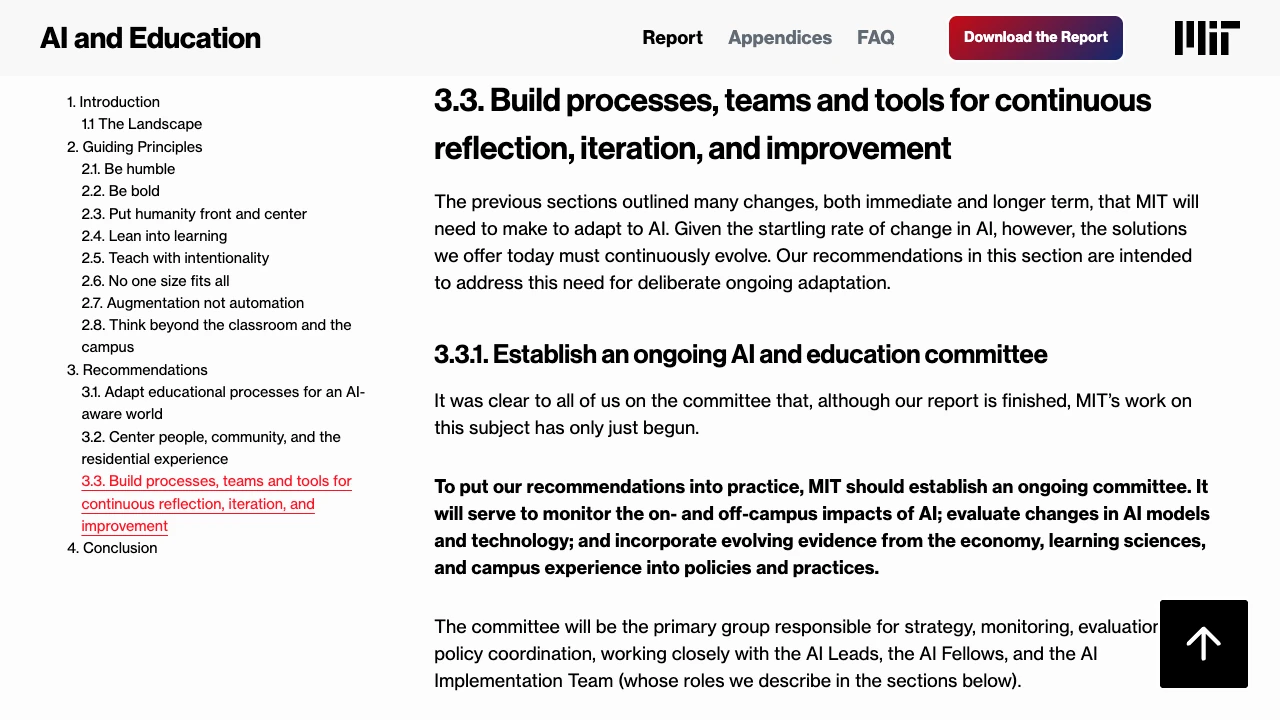
The report proposes a governance structure that can keep adapting: an ongoing committee, AI Leads across the schools, AI Fellows, an AI Implementation Team, and a Pilot Fund.
The proposal goes beyond issuing an AI policy. It calls for a system that continually observes, experiments, measures, and revises.
This is an answer at the level of organizational design.
The AI Pilot Fund deserves attention
MIT recognizes a practical problem. You cannot tell a professor to redesign an entire course, then provide no funding, no additional teaching assistants, and no reduction in workload.
The proposed AI Pilot Fund could support AI credits, teaching assistants, undergraduate research through UROP, and summer work.
The interesting part is that it would fund both AI-enabled experiments and deliberately AI-free experiences.
That wording captures the report’s position particularly well. MIT is neither pro-AI nor anti-AI. It is pro-learning.
3.3.7 An easily overlooked issue: AI access is already a question of educational equity
The report raises a concrete problem. A top-tier AI subscription can cost $200 per month; API use and coding agents can cost still more.
Student A has access to the best models. Student B has only free ones. If a course permits AI, the difference is no longer just about technology access. It may become a direct academic advantage.
MIT therefore supports Parley, its model-agnostic campus AI platform, and discusses expanding credits and access to agentic tools.
A new educational equity question emerges. Universities once needed to ensure access to laboratories, books, and computers. They may now also need to ensure access to compute and model intelligence.
3.3.8–3.3.9 Privacy will matter more and more
If a university gives you an official AI tool, can the university see your prompts? Can your teachers? How long are they kept? Could chat logs be used to judge whether you have learned?
If a student discusses health, relationships, anxiety, or personal life with AI, what access should the university have?
MIT does not pretend to have all the answers. It says that rules for logging, auditing, and privacy must be discussed openly and resolved transparently.
This could become a major issue. AI differs from an ordinary learning management system. Canvas or Blackboard knows what you clicked. AI may know what you are thinking about.
Putting all of Section 3 into one sequence
AI makes producing an output cheaper.
↓
A university can no longer assume output ≈ learning.
↓
It must redefine learning outcomes.
↓
It must then redesign assessment.
↓
Assessment moves beyond the final answer to process, explanation, judgment, and application.
↓
At the same time, it protects productive struggle, social learning, and mentorship.
↓
AI provides augmentation, rather than cognitive replacement.
↓
Finally, the university builds institutions that keep experimenting, measuring, and revising.
What I most want you to remember from Section 3 is not one particular policy, but a question beneath the whole chapter:
When producing a good answer becomes cheaper, what becomes more valuable?
MIT’s answer gradually emerges: judgment, deep understanding, original problem formulation, human collaboration, mentorship, agency, taste, and the willingness to experience productive struggle yourself.
AI has not made education unimportant. It may finally force us to acknowledge that the real product of education was never the assignment. It is the person who remains after the education is complete.
That is also why I think Section 3.1.6 on grades and Section 3.1.5 on AI agents replacing undergraduate research work in UROP deserve especially close reading. They go beyond AI to reopen the question of what education means.
You can continue with the MIT report.
AI contribution
ChatGPT in the browser analyzed and interpreted the report. Biaoo assessed and selected its arguments, then shared those he found valuable. Codex translated the published Chinese article into English.