ICLR Submissions Passed 60,000—Faster Than I Expected
A comparison of ICLR submission volumes raises questions about AI-driven research growth and the rules that might match its pace.

Over the past couple of days, I saw the submission figures for ICLR 2027: the abstract-stage volume has already passed 62,000. Compared with roughly 19,500 valid submissions to ICLR 2026, that is more than three times as many.
An even more striking comparison: across the fourteen editions from 2013 through 2026, total submissions amounted to only about 56,000. The abstract-stage volume for ICLR 2027 alone has already exceeded the total for all previous editions combined.
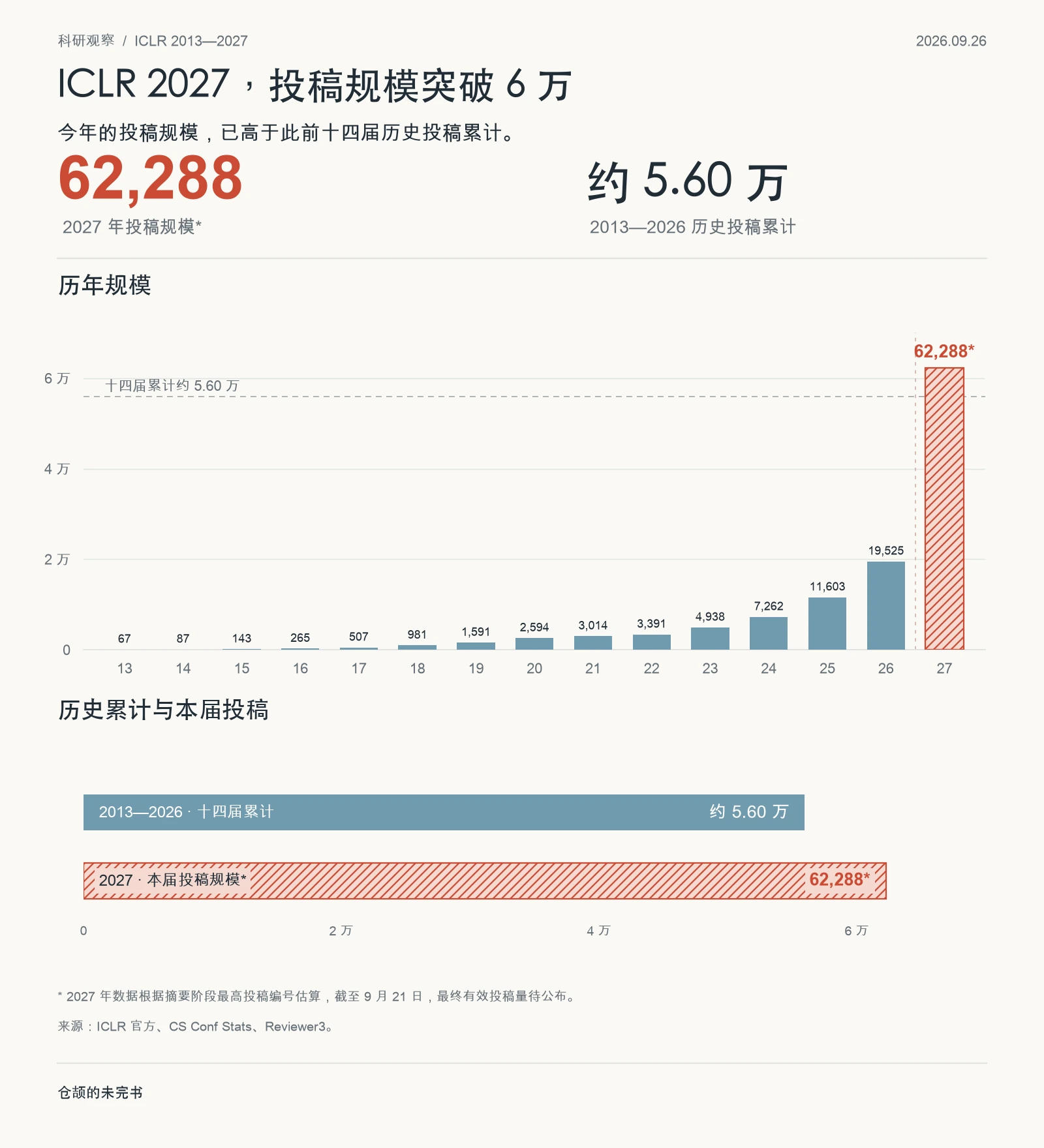
The 2027 figure is estimated from the highest submission identifier as of September 21; the final number of valid submissions has yet to be announced. The 2026 figure counts valid submissions. The two figures are used to compare scale. Statistical methods.
I expected AI’s involvement in research and paper writing to bring a sharp wave of growth. I did not expect it to arrive this quickly.
Right now.
ICLR 2027 has already passed 62,000. How many will there be in 2028?
What might new rules look like if they are to match this pace of production?
This reminds me of an article I read earlier, “PDF Must Go; ARA Must Rise! It’s Time for Papers to Become Agent-Native”. It introduces ARA, an attempt to organize research processes, code, and evidence into materials AI can directly read and execute.
Perhaps AI will become a paper’s first reader. If papers are first read, checked, or even experimentally reproduced by AI, how they are written and reviewed may change as well.
Sources:
- Submission volume: Reviewer3’s statistics and methods.
- Historical submission data: CS Conf Stats and official ICLR fact sheets; official 2026 figures.
- The ARA paper: The Last Human-Written Paper: Agent-Native Research Artifacts.
AI contribution
The author proposed the topic and central judgment, and wrote and revised key paragraphs. AI helped find sources, plot the data, organize the text, and create the cover. AI translated the Chinese article into English for the blog, with the author responsible for publication decisions.