Assessment in the AI Era: Understanding, Judgment, and Transfer in CMU’s Database Course
CMU’s database course points toward assessment built around submitted work: showing what students have learned and developing their ability to keep working with AI-assisted results.
In this essay
In fall 2026, Carnegie Mellon University’s database course, 15-445/645, sets different rules for AI coding agents across its programming projects: they are prohibited in the first two and permitted in the last two. Whoever generates the code, students must understand what they submit, explain its design, identify problems, and make reasonable modifications. [1]
The course includes two Debugging & Reasoning Checks built around this requirement. Students receive excerpts from their own submitted code, possibly with comments removed. They need to explain how it works. They may also encounter subtle bugs introduced into the code and be asked to identify the problem, analyze its consequences, and explain how to fix it. [1]
After submission, the program becomes material for further analysis and problem-solving. This suggests a direction worth extending to assessment in the AI era: students can use tools to produce work while also being expected to understand the knowledge it involves, make judgments supported by reasons, and continue applying that knowledge when the problem changes.
Assessing students’ understanding, judgment, and ability to transfer knowledge through the work they submit may become the most important form of course assessment in the AI era. It sets a complete expectation for learning: produce a piece of work and be able to continue working from it.
1. What can students do once the work is complete?
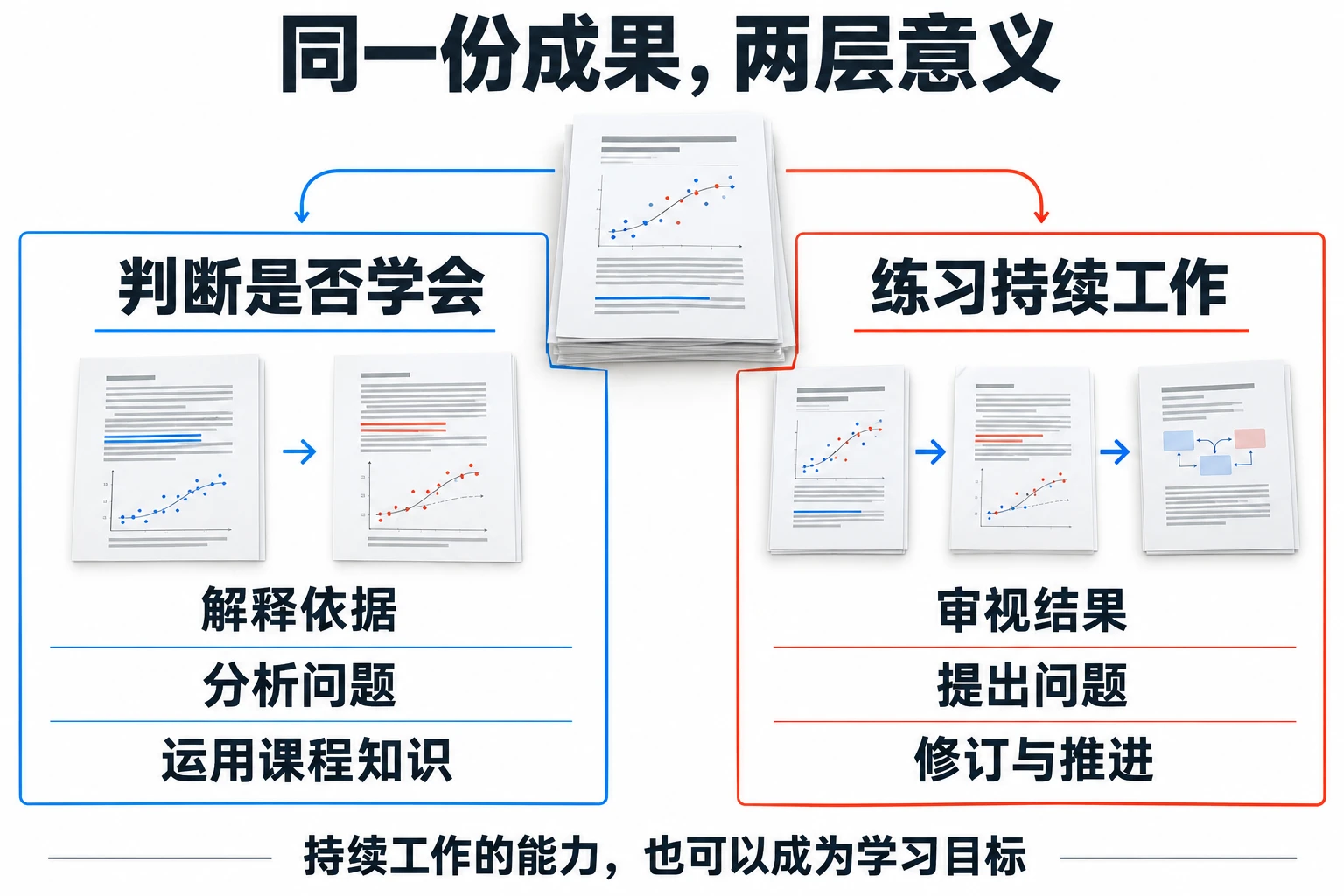
Two purposes of assessment: establish whether students can explain their reasoning, analyze problems, and apply course knowledge; and help them practice examining results, asking further questions, revising, and moving the work forward. The ability to keep working can itself be a learning objective.
A working program means that the immediate task has produced a result. Using and developing it further raises other questions: Why is it structured this way? Will it still work correctly if the input changes? What needs to change when a new requirement arises?
Answering these questions requires students to know the subject matter behind the program and to be able to read, analyze, and adapt existing code. As AI takes a larger role in code generation, how students understand and work with code may become a more important part of a course’s learning objectives.
CMU calls students’ command of their submitted code code ownership. The requirement covers all submitted code, including code generated with AI where its use is permitted. Alongside the written Debugging & Reasoning Checks, the course includes face-to-face Code Reasoning Interviews with teaching assistants. Every student takes part at least once, explaining, debugging, or modifying code from their own project. [1]
These expectations also appear in the grading structure. Projects account for 40% of the overall course grade: 30 percentage points for submissions and 10 for the two Debugging & Reasoning Checks. [2] Students are assessed both on the programs they hand in and on how they understand and work with those programs.
A similar direction has emerged in public discussion among teachers. In September 2026, the Computer Science Teachers Association (CSTA) published an article by Shreyas Rane on asking students to explain, test, adapt, and justify design decisions in submitted code. He calls these practices verification-based assessment and treats reading, testing, debugging, and design judgment as important work within computer science itself. [3]
Such tasks first help teachers determine whether students have met the course’s learning objectives. Similar submissions can reflect different levels of understanding. Through students’ explanations of design choices, analyses of problems, and actual modifications, teachers can learn more about whether they understand the relevant knowledge and can use it to make judgments and solve problems.
These tasks also point toward a way of working with AI. After producing a result with AI’s help, a person needs to understand it, judge which parts are reliable and under what conditions they apply, and decide what to do next in light of new information and requirements. The result can be revised or become the basis for a new question or a further piece of work. This ability to keep applying knowledge may also become an increasingly important educational goal.
The two purposes are connected: assessment helps teachers find out whether students have learned, while the ability to continue working from AI-assisted results can itself be something a course aims to teach.
This form of assessment both tests students’ command of knowledge and methods and guides them in continuing to use that knowledge in work involving AI. Making these expectations clear when setting an assignment gives students a reason to practice understanding, judgment, and further development while producing their work.
2. Turning a report into the starting point for further research
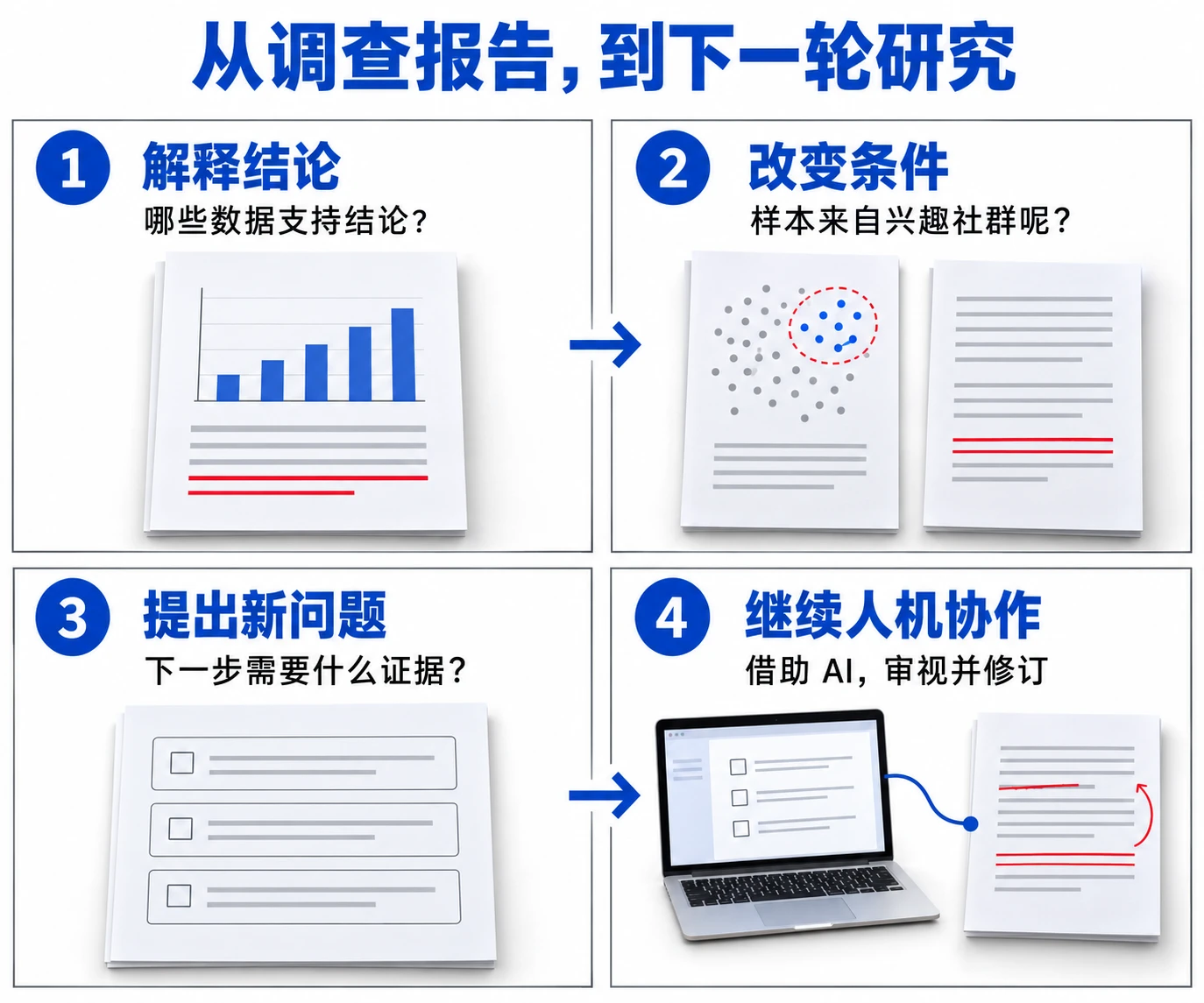
From a survey report to the next round of research: Which data support the conclusion? What changes if respondents come from an interest group? What evidence does the next question require? How can AI help while the student examines and revises the work? The report and charts are illustrative.
To consider how this form of assessment could work beyond programming, take a survey report.
Suppose a research methods course allows students to use AI to organize sources, analyze data, and draft reports. A student completes a survey of reading on campus and concludes, based on the questionnaire responses, that students at the university are broadly receptive to digital reading.
The teacher could ask: Which data support that conclusion? Does the questionnaire record reading frequency, reading habits, or reading preferences? What questions can each of these measures answer?
Here, the student needs to apply research methods. They must connect concepts, measurement, and conclusions, explaining how they moved from questionnaire responses to a judgment about reading on campus.
The teacher could then introduce a change: What if the questionnaire had been distributed mainly through a group for people interested in digital reading? How should the original conclusion change?
The student needs to judge whom the sample can represent, identify which inferences are affected, and revise the scope of the conclusion. To continue the study, they also need to explain how to supplement the sample and what problems the new sampling approach would address.
The revision required here involves actually dealing with a research problem. Saying “the sample is biased” is only a beginning. The student also needs to understand what the bias affects and bring the revised report into line with the evidence.
The research can also move forward through a new question. Suppose the next step is to explore the relationship between how frequently people read digitally and their engagement with reading. Is the original questionnaire sufficient? Which data remain useful? How should “reading engagement” be defined and observed?
Students can propose their own follow-up questions, explain why they are worth pursuing, and plan the evidence they would need to collect. Teachers can then assess whether they can formulate researchable questions, choose suitable methods, and recognize what existing material can support.
These responses give teachers evidence of students’ command of research methods: Do the measures correspond to the concepts? Do inferences stay within what the evidence supports? Do revisions address the problem? Can the proposed next steps obtain the information needed? Students can offer different approaches, provided they explain their reasons.
Further research can also involve collaboration with AI. A student might use AI to organize the literature and propose a draft questionnaire, then judge which sources are relevant to the research question and which questions will yield the information needed. When new survey results arrive, the student must decide how to interpret them and whether to revise earlier judgments.
What students practice is a process that can continue: understand existing work, pose the next question, select methods, and adjust judgments in response to new results. AI can participate at several stages, while students use research methods to connect those stages into a reasoned investigation. A report becomes a starting point for further work.
These arrangements can be explained when the survey assignment is introduced. Students then have reason to keep considering these questions while using AI to analyze data and organize their writing. Their learning extends from completing a report to understanding the research, examining its conclusions, and taking it further.
3. Applying knowledge when the problem changes
Different courses can design tasks that follow a completed piece of work around their own learning objectives.
In a writing course, after students submit an essay, the teacher could provide new material related to its central argument and ask them to judge how it relates to the existing evidence. Some material might weaken the original claim; some might affect only one qualification; other material might strengthen the argument. Students need to decide how to use it and actually revise the relevant passage.
This brings assessment into the judgments involved in writing: Does the author understand what support a claim needs? Can they distinguish the roles different pieces of evidence play? Can they adjust the argument accordingly? The essay is finished, but the thinking can continue.
In a design course, the teacher could change one condition under which a design will be used. An interface originally intended for experienced users, for example, now needs to serve people encountering it for the first time. Students would analyze which design decisions are affected, choose one aspect to modify, and explain how the revised design responds to those users’ needs.
Such a task requires students to understand the existing design and make choices in a new situation. Teachers can assess their analysis of the problem, the reasons for their revisions, and the results, rather than relying only on a prepared presentation of the work.
These practices share a structure: start with work students have completed, identify the knowledge and judgments relevant to the learning objectives, and ask students to keep applying them through explanation, changed conditions, or an extension of the work.
Teachers can set the tasks, or students can propose hypotheses worth testing, improvements to make, or new directions for application, explaining their reasons. A course still needs clear assessment criteria while leaving room for different lines of reasoning and different solutions.
Whether revising an argument or adapting a design, students must use subject knowledge to make new judgments. Their performance helps teachers understand their command of that knowledge while giving students practice in continuing from existing work.
4. How assessment can guide learning
Including these tasks in a course also changes assignment design.
Teachers can explain the required output, the permitted uses of AI, and the follow-up tasks together: What must students produce? Where may they use tools? Which key judgments must they be able to explain? How will they be asked to respond to changed conditions? Students can understand the whole assignment and keep track of the knowledge they need to master as they use tools.
A research methods course, for example, could make clear at the outset that students will need to explain how key measures capture the subject of their study, judge the scope of their conclusions, and revise their plans when survey conditions change. These expectations can be part of classroom practice and feedback along the way before entering formal assessment.
Learning objectives also determine how follow-up tasks are organized. Assessing reasoning requires time for analysis. Assessing revision requires students to carry out a revision. Assessing research design requires examining whether the proposed question and evidence plan fit together. Written tasks, interviews, practical exercises, and revisions over several stages can all be appropriate forms.
Work completed independently helps teachers understand what students themselves know and can do. In tasks that permit tools, students’ explanations of their choices and judgments about tool outputs can also be assessed. Courses can set tool permissions according to the abilities being assessed, giving both human–AI collaboration and individual application of knowledge a clear place.
Teachers need not redesign every assignment at once. They can select a part of a report, design, or program that carries a central learning objective, arrange a focused task involving explanation, modification, or further development, and gradually build up practices suited to the course.
If these tasks become a regular part of a course, students will know from the moment an assignment is set what further work is worth doing after producing a polished result. That further work can then have a place in classroom practice, feedback, and formal assessment.
I think an important change in future assessment may lie in attending to both the quality of the work and students’ ability to understand it, exercise judgment, and develop it further. Teachers can use this to judge whether students have learned, while students practice treating a piece of work as a starting point for continued collaboration with AI, application of knowledge, and progress on the task.
Sources
- CMU 15-445/645 Database Systems FAQ, Fall 2026
- CMU 15-445/645 Database Systems Syllabus, Fall 2026
- Shreyas Rane: AI Has Not Made Computer Science Assessment Obsolete. It Has Made Verification Essential., CSTA, September 8, 2026.
AI contribution
The author determined the topic, central ideas, tone of the argument, and direction of revisions. AI assisted with source checking, structure, rewriting, and image generation. AI also translated the article into English and added English descriptions and captions for the original illustrations.