ChatGPT: From AI Tutor to Student OS
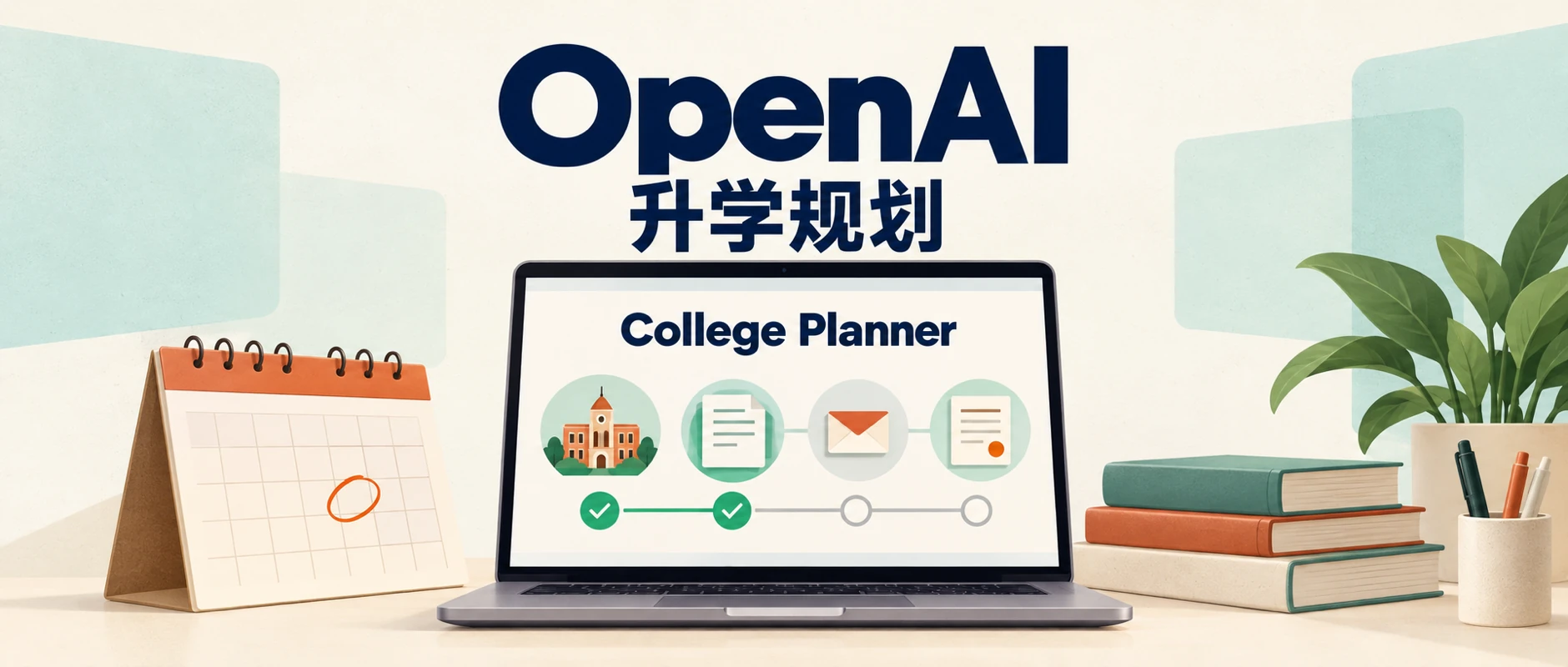
College Planner points beyond answering a student's question toward managing ongoing goals, records, and tasks. What would an education product organized around the learner look like?
In this essay
- 1. From solving a problem to managing an ongoing process
- 2. Why discuss Student OS?
- 3. Competition may shift from features to persistent learner state
- 4. The hardest part of Student OS may go beyond technology
- 5. What still separates College Planner from Student OS?
- 6. The centre of education products may shift from courses to students
On October 7, 2026, OpenAI published “Helping teens learn, plan, and shape the future of AI,” describing the latest developments in ChatGPT for Teens. The update covers several features: turning class notes into flashcards and quizzes, learning step by step with Study Mode, and a forthcoming feature called College Planner. [1]
I’m more interested in that last feature. College Planner is designed for US high-school students in grades 10–12 who plan to apply to four-year colleges. It helps them organize application requirements, deadlines, tasks, and financial-aid steps.
Students can manage applications to different colleges in one plan, view a timeline, update their progress, and ask ChatGPT what a requirement means or how to get started. OpenAI also plans to expand it to more countries and to educational pathways including two-year colleges, technical colleges, and trade schools. [1]
Taken alone, this looks like a college-planning tool added to ChatGPT. But alongside Study Mode, flashcards, quizzes, and ChatGPT’s existing memory and task capabilities, I see a more interesting shift:
ChatGPT is moving from answering students’ questions toward helping manage their ongoing learning and education tasks.
This brings a concept to mind: Student OS. It isn’t OpenAI’s official name for these products. It’s a way I want to describe a possible direction in their development.
1. From solving a problem to managing an ongoing process
Over the past few years, AI Tutor has been a natural product form for AI in education. A student sends AI a mathematics problem they cannot solve. AI explains the concepts, breaks down the steps, and asks guiding questions to help them understand. A student exploring a new concept can also ask AI to explain it at a level and pace that suit them.
This model is relatively mature. OpenAI’s Study Mode, introduced in July 2025, follows this direction. Rather than always providing an answer directly, it uses step-by-step guidance, knowledge checks, and personalized feedback to support a learning activity. [2]
But this kind of AI Tutor has a defining feature: it is usually organized around the current learning problem. The learner asks a question; the system helps. Even when it draws on previous conversations, the main unit of interaction remains a question, an exercise, or a learning session.
College Planner is somewhat different. Applying to college cannot be completed in one conversation. A student might start exploring colleges and majors in grade 10, narrow their list in grade 11, and prepare materials, submit applications, apply for aid, and decide between offers in grade 12. This process can span years. It involves multiple goals, different deadlines, changing personal circumstances, and actions that students, families, schools, and colleges must each take.
If ChatGPT only answers “What materials does this college require?”, it remains a question-answering tool. If it can retain the student’s plan, record completed tasks, remind them of upcoming milestones, and continue working on the same plan when they return, its role changes. It begins to manage an ongoing task process as well as information.
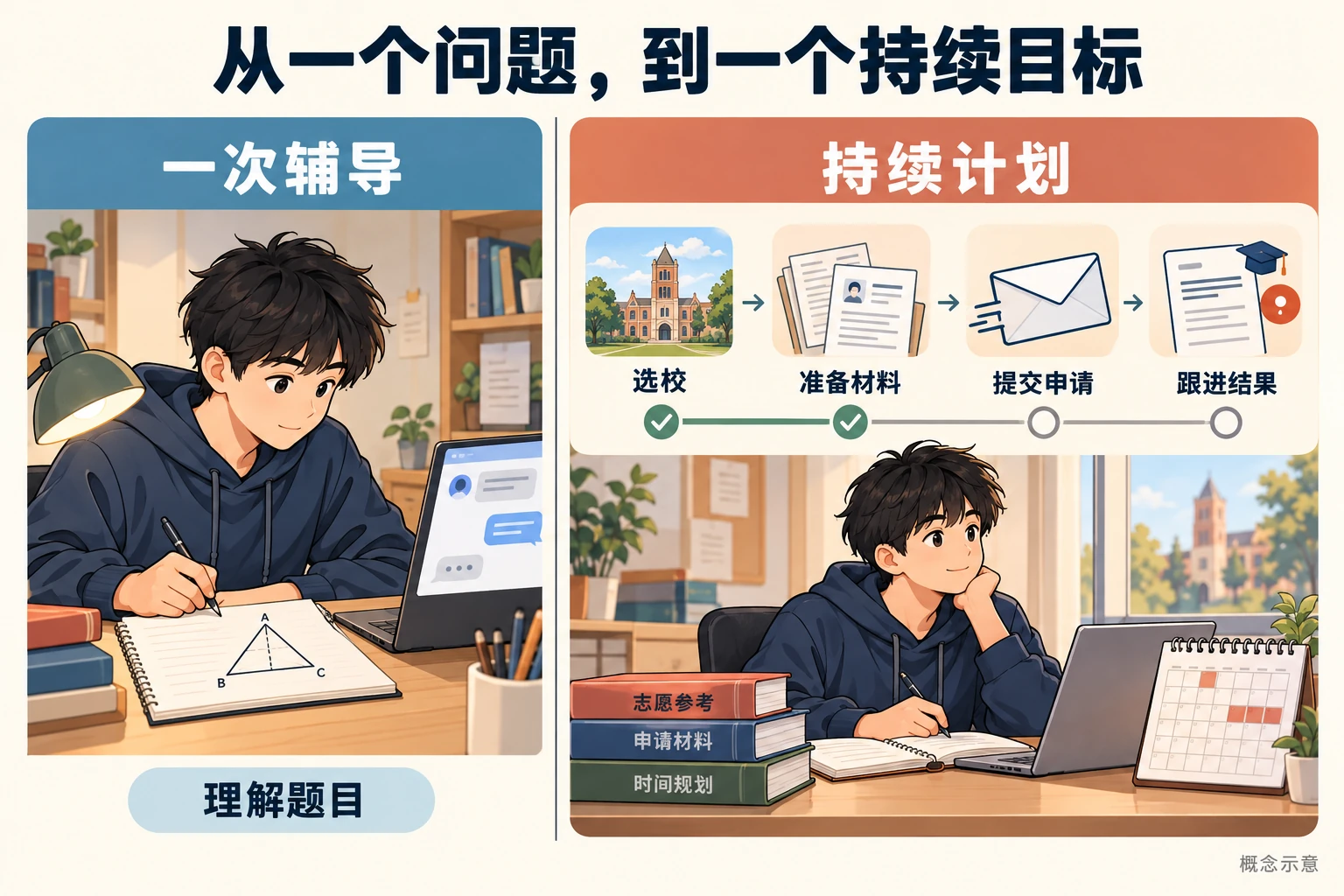
The progression can be simplified like this:
- AI Tutor: helps with an individual learning activity.
- AI Planner: organizes tasks, progress, and information around an ongoing goal.
- Student OS: brings together a student’s multiple long-term goals, learning state, and available tools.
College Planner is still only one limited setting within this progression. It doesn’t make ChatGPT a Student OS. What interests me is where it is shifting the focus of product design.
2. Why discuss Student OS?
Consider how a student’s digital learning life is organized. They might use a school LMS for courses and assignments, a note-taking app for materials, the vocabulary app Baicizhan to study words, a calendar for examination dates, ChatGPT to understand concepts, and other tools to apply to colleges or record extracurricular activities.
Each tool handles a kind of task. But the student’s learning goals do not follow those software boundaries.
Suppose a student wants to pass an English examination in three months. To do that, they need to know their current ability, the examination date, the time they can commit each day, and their difficulties in reading, listening, writing, and speaking. They need courses and exercises, ongoing review, adjustments based on practice results, and registration and preparation before the examination. This is a problem of managing a changing state over time, beyond generating content.
Traditional education software often covers only part of the process. A vocabulary app knows which words the student remembers but may not know their examination goal. A calendar knows the date but not how prepared they are. An AI Tutor may know what they are studying but not what happens in other tools.
To keep helping a student toward a goal, an AI system needs a structure that connects these activities. I call that Student OS for now. Here, OS does not mean an operating system like Windows or macOS, nor does it imply control over devices or computing resources. It is closer to a personal environment organized around the student.
I think such a system needs at least four capabilities.
First, a persistent learner state. It needs to distinguish relatively stable personal information, current goals, completed tasks, and evidence produced by different learning activities. “Preparing for IELTS,” “relatively weak in reading,” “completed a set of exercises,” and “has a mock examination next week” describe different kinds of state and require different updates. The model cannot be left to reconstruct all this by guessing from a long conversation.
Second, goals and tasks managed across time. When a student completes an exercise today, the system should understand what that means for their longer-term goal. An unfinished task may need rescheduling. A change in the student’s goal should prompt changes in the plan. What matters is whether the plan continues to work in real life, beyond how impressive it looks when generated.
Third, access to different tools and services. A student’s activities cannot all happen in one chat window. Learning materials may come from school, practice may happen in a specialized app, formal applications must go through colleges or application platforms, and examination results come from independent testing organizations. Student OS would therefore likely need tools, skills, connectors, or other interfaces to work with different education services.
Fourth, control centred on the learner. Students need to know what the system records, what its judgments are based on, which actions require their confirmation, and how to change, export, or delete their information. Especially for minors, these should be part of the product’s design.
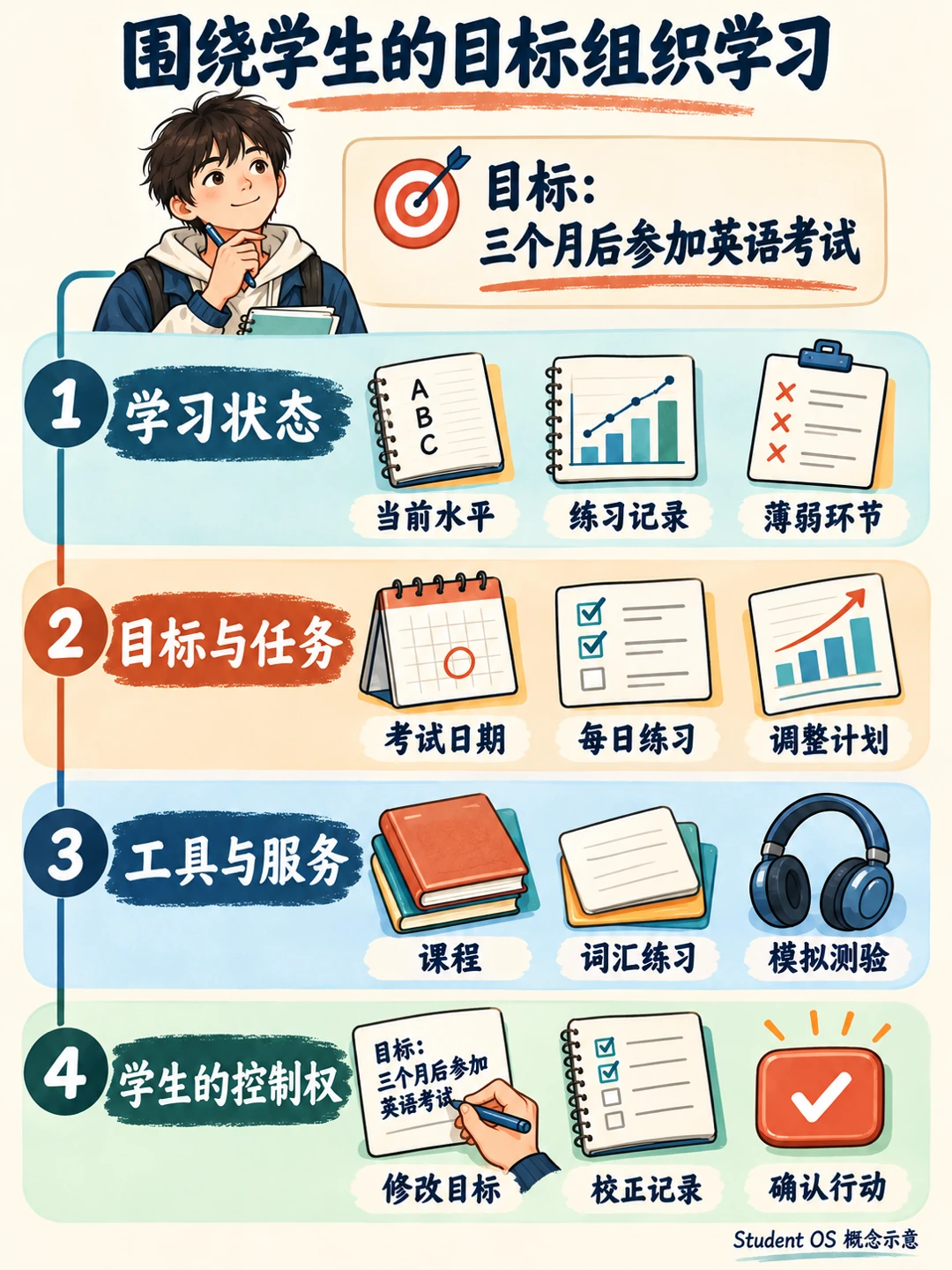
The structure can be summarized as:
Student OS = Learner State + Goals + Workflows + Tools + Permissions
This is an abstract model for understanding the product structure, not an established technical standard.
College Planner is interesting because its announced design includes two core elements: a persistent plan and task states that are updated around that plan. The same update also describes flashcards saved in a teen’s Library and scheduled tasks for review. Individually, these features are straightforward. Together, they suggest a shift from single interactions toward managing ongoing activities. [1]
3. Competition may shift from features to persistent learner state
When discussing AI education products, we have often compared model capabilities and feature quality: whose explanations are better, whose questions are more accurate, whose exercises better fit the student’s level, and whose courses are more polished. These matter. But as general-purpose models improve, content generation and question-answering features may become harder to sustain as lasting product differences.
For example, an independent AI learning product can generate flashcards, create quizzes, and prepare a study plan. ChatGPT can gradually acquire similar capabilities. If their content quality converges, why would a user open the independent product?
One answer could be deeper instructional design, more reliable assessment, or closer connections to school curricula and teaching practices.
Another concerns data and state. A system that has recorded a student’s learning activities for six months or several years has an opportunity to understand their goals, habits, progress, and past difficulties, and to provide continuity of service. That is substantially different from generating a study plan once.
Generating a plan relies on model capabilities. Keeping it running relies on state, tools, real feedback, and mechanisms that work over time. As AI education products develop into agents, I think the latter will become increasingly important.
OpenAI is not the first company to enter this space. The US already has established college application and planning services such as Common App and Scoir. Common App provides applications, requirements, and deadlines. Scoir helps students manage college lists and application progress, and work with families, counselors, and schools. College Planner did not invent college application task management. [3][4]
The development worth watching is that general-purpose AI products are integrating workflows previously handled by specialized education systems into natural-language interaction and broader personal AI use.
Previously, a student had to enter a particular product to complete its tasks. In the future, they may describe a goal to their general-purpose agent first, and let the agent select appropriate tools, look up information, maintain state, and help move the tasks forward.
If this model takes hold, specialized education apps may change their place in the wider product landscape. Some will retain their own interfaces and user relationships. Others may act more like services that offer agents specialized capabilities: courses, exercises, assessment, application processing, or learning records. Directly serving the student, maintaining authoritative records, and holding permission to execute formal actions may become separate responsibilities.
Behind this is a larger shift. Most digital education products have had a clear functional centre. Course platforms organize content and activities around courses; practice software organizes training and feedback around questions; school information systems organize student data around teaching administration. Students switch between these systems and connect their information and tasks themselves.
If an AI agent can understand a learner’s goals over time, record results from different activities, and coordinate education services, that organizing centre may change. Students have adapted to the boundaries of different software products. In the future, those products’ capabilities may be organized around students’ goals.
This is what makes Student OS interesting as a product concept. It may create a persistent environment centred on the learner by integrating existing specialized capabilities, without rebuilding every educational function. Future competition may therefore depend on who can reliably maintain a learner’s long-term state and, with their authorization, organize and access other educational capabilities, alongside the strength of models and the breadth of features.
4. The hardest part of Student OS may go beyond technology
Suppose an agent could accompany a student over a long period. It knows which colleges they hope to apply to, their grades and interests, and the courses they have completed. It can even help plan their learning and applications for the next several years. A question follows:
Who has the authority to decide what this student should do next?
In traditional software, this question is often less obvious. A calendar reminds someone of deadlines but does not decide which college they should apply to. Practice software recommends questions but usually does not change their educational path for the next few years. When these functions come together in an agent that continuously plans and suggests actions, its influence may extend beyond an individual task.
For example, an agent might use the student’s grades and learning record to judge that their chances at a particular college are low. It could recommend dropping that college and spending time on more attainable choices. From an efficiency perspective, that seems reasonable.
But efficiency is only one dimension of an educational decision. A student may be willing to take a risk, want to explore a field they are not yet good at, or change their interests after an important experience. If a system always recommends the path most likely to succeed based on existing records, it may make the student more efficient while making it harder for them to move beyond a description of their past self.

AI can offer advice, but the system must distinguish different actions. Explaining a college’s requirements is different from deciding whether to apply there. Reminding a student to complete a task is different from changing their long-term goal. Helping improve application materials is different from inventing experiences or evidence of abilities the student does not have.
Student OS therefore needs to design boundaries for action, beyond trying to automate as much as possible. Which operations can run automatically, and which require consent? Which results can a model estimate, and which must come from authoritative school, examination, or application records? Which learning achievements must students produce themselves to count as reliable evidence of their abilities?
These questions become part of the product architecture. In technical terms, it needs permissions, provenance, and accountability alongside an agent’s action space: who can act, what information supports the action, and who is responsible for the result.
For minors, this also involves privacy, family participation, school responsibility, and educational equity. A Student OS that maintains long-term learning state may hold extensive sensitive information about learning difficulties, habits, personal goals, and even psychological state or family circumstances.
Who can read this information? Can students take their records with them when they become adults? Can they refuse particular kinds of personalized analysis? Can they continue learning after leaving the platform? These may help determine whether such a system can become part of education.
5. What still separates College Planner from Student OS?
Returning to College Planner, I think it gives us a direction to observe. It does not establish that Student OS has arrived.
First, saving a plan does not mean the system has developed a learner model. Students can manually update application tasks, and the system can display progress from those task states. That remains far from continuously understanding their actual abilities, experiences, and educational goals.
Second, reminders do not establish reliable execution of complex tasks. An application may involve different colleges’ real requirements, changing deadlines, formal documents requiring personal confirmation, and collaboration between institutions. Without reliable sources, clear permissions, and confirmation of task states, an agent will struggle to handle critical processes.
Third, growth in use does not prove educational effectiveness. OpenAI reports that nearly 1.2 million teens used Learning Visualizations in one week, and more than 180,000 used Study Mode. [1] These figures show substantial use but do not tell us the long-term learning outcomes.
I think we should watch for at least three signals.
The first is whether long-term learner state can be established. Can ChatGPT organize information from different learning activities into persistent state that can be managed and corrected, beyond referring to past information in conversations?
The second is whether collaboration across platforms actually happens. Can it work reliably with specialized education services, for example by reading authoritative course and application data, receiving confirmed learning results, and completing tasks across systems with clear authorization?
The third is whether this product form creates educational value. Does continuously managing a student’s learning activities improve learning, capability development, and decision-making? Or does it mainly make tasks easier to finish while increasing dependence on AI?
Adding more educational features to ChatGPT could make it a rich education super-app. But if it can organize goals, state, tasks, tools, and permissions around the learner and keep working across time, we may have reason to call it Student OS. These forms may look similar, but their architecture and educational significance are different.
6. The centre of education products may shift from courses to students
Looking back at digital education products, we have built resource platforms around content, LMSs around courses, teaching tools around classrooms, and AI Tutors around individual problems. Each has its own organizing centre. Course systems manage courses, practice systems manage questions, and school systems manage students and teaching activities.
But a student’s learning experience does not naturally fit within any single course, school, or examination. They move between courses and educational stages, learn in different settings, leave records in different tools, and keep adjusting their goals.
As AI agents take on more information organization and task coordination, another way of organizing products becomes possible: different educational capabilities can work together around a student’s ongoing goals, rather than requiring the student to organize their learning around separate education products.
This may be what makes Student OS most worth studying. Schools, teachers, and specialized education software still have a role. If this product form takes shape, the contributions of schools, teachers, course platforms, testing organizations, and other providers may need to be made clearer. Students can hold their own goals and learning histories, but official grades, credentials, educational responsibility, and social trust cannot simply be supplied by a private AI assistant alone.
I also do not think Student OS necessarily belongs to ChatGPT. It could emerge from general-purpose AI, a school-led system, or a personal learning environment built on open protocols. Who holds the learner’s long-term state, who maintains data and permissions, and who provides trusted educational capabilities may become important questions in the next stage of competition.
College Planner is currently a college-planning feature. But it has made me take a shift seriously: we have wanted AI to help students understand problems like a teacher. In the future, we may also want it to help them organize their learning experiences like a personal system that keeps running.
The former focuses on completing a learning activity. The latter concerns how a learner develops over time.
Education still faces a more basic question: as systems become better at managing goals, scheduling tasks, offering advice, and taking action, how should we design them so that students gain greater ability and freedom to develop themselves, rather than gradually lose control over their own learning?
For me, that is the most important question in the move from AI Tutor to Student OS.
Sources
[1] OpenAI: Helping teens learn, plan, and shape the future of AI, October 7, 2026.
[2] OpenAI: Introducing study mode in ChatGPT, July 29, 2025.
[3] Common App: Application guide for first-year students: requirements, deadlines, and the application process.
[4] Scoir: Students and Families: college lists, application progress, and collaboration with counselors and families.
Note: OpenAI described College Planner as a forthcoming feature in its October 7 announcement. This article analyzes the announced design and does not evaluate its practical effectiveness. Student OS is an analytical concept; the discussion of long-term learner state, cross-platform agent collaboration, and future competition is my own extrapolation, not an OpenAI-announced product or roadmap. I will continue to follow College Planner’s launch, practical effectiveness, and feature development.
AI contribution
The author selected the core material and direction, reviewed the text, and adjusted key wording through successive rounds. AI helped check sources, organize the text, and design and generate the cover and in-article illustrations. AI translated the Chinese article into English for the blog, with the author responsible for publication decisions.