Two Million Credit Packages, 416 Universities, 1,176 Campus Skills: What Are AI Agents Competing for?
Campus Skills and back-to-school campaigns offer a way to examine the industry logic of general-purpose agents entering education.

Some numbers from WorkBuddy’s back-to-school campaign caught my attention.
It offered university students 1,000 credits each, initially limited to two million packages. Its earlier campus Skill competition drew 874 creators from 416 universities, who made 1,176 campus Skills.
In the previous article, I tested WorkBuddy and Penguin Teacher Assistant from both user and development perspectives. Here I want to step back and consider WorkBuddy alongside Doubao Work and Qwen Office: what do these numbers tell us about the industry structure and the growth of an ecosystem?
Back to the “lobster”
OpenClaw, nicknamed the “lobster” in China and widely discussed earlier this year, helped popularize an agent architecture built around a model, tools, and a persistent execution environment.
In that architecture, the model interprets a task and decides what to do next. An agent calls tools to search, process documents, and perform other actions, then passes the results back to the model to continue.
OpenClaw can run on a personal computer. If a task must keep going after the computer is off, it can instead run on an always-on cloud server. Searching the web and processing documents then use that server’s computing resources.
Long-running work also requires space to keep prior materials, records, and generated files for later tasks. Remote model calls, searches, and downloads create network traffic as well.
Taken together, these needs reveal the technical picture behind a general-purpose agent: how tasks are organized and executed, how information and state persist, and which infrastructure supports those capabilities.
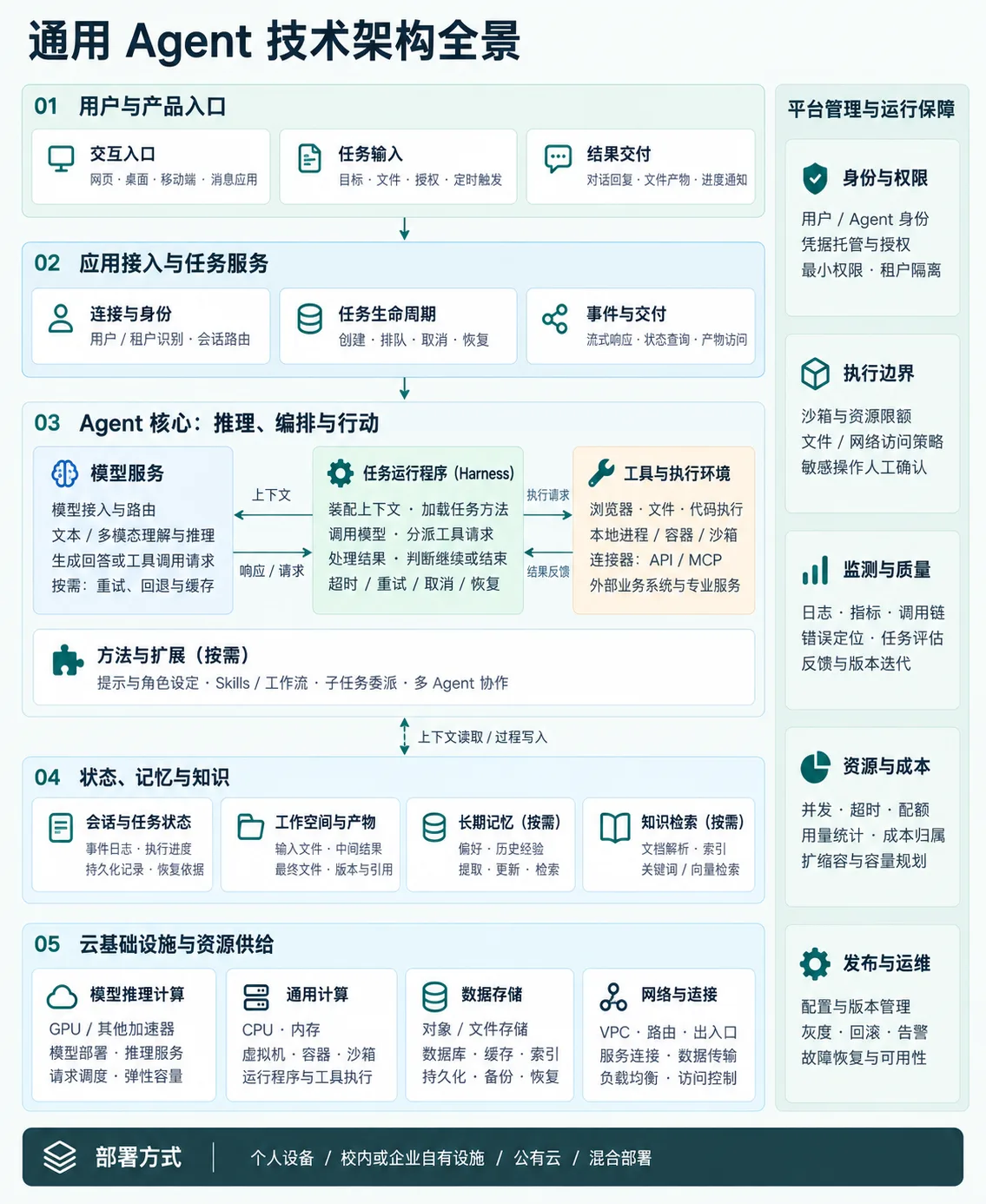
Integrating models, applications, and cloud infrastructure
The architecture shows that a general-purpose agent needs both model-based reasoning and the computation, storage, and networking to run tasks continuously. In that light, recent organizational changes at ByteDance, Alibaba, and Tencent become easier to understand.
In July, ByteDance brought together product teams from Feishu and Doubao and aligned Feishu’s marketing, sales, and customer-service organizations with teams from Volcano Engine. Around the same period, Alibaba consolidated several agent products into Qwen Office, while Tencent moved QClaw-related work and some teams into the cloud-product division that houses WorkBuddy.
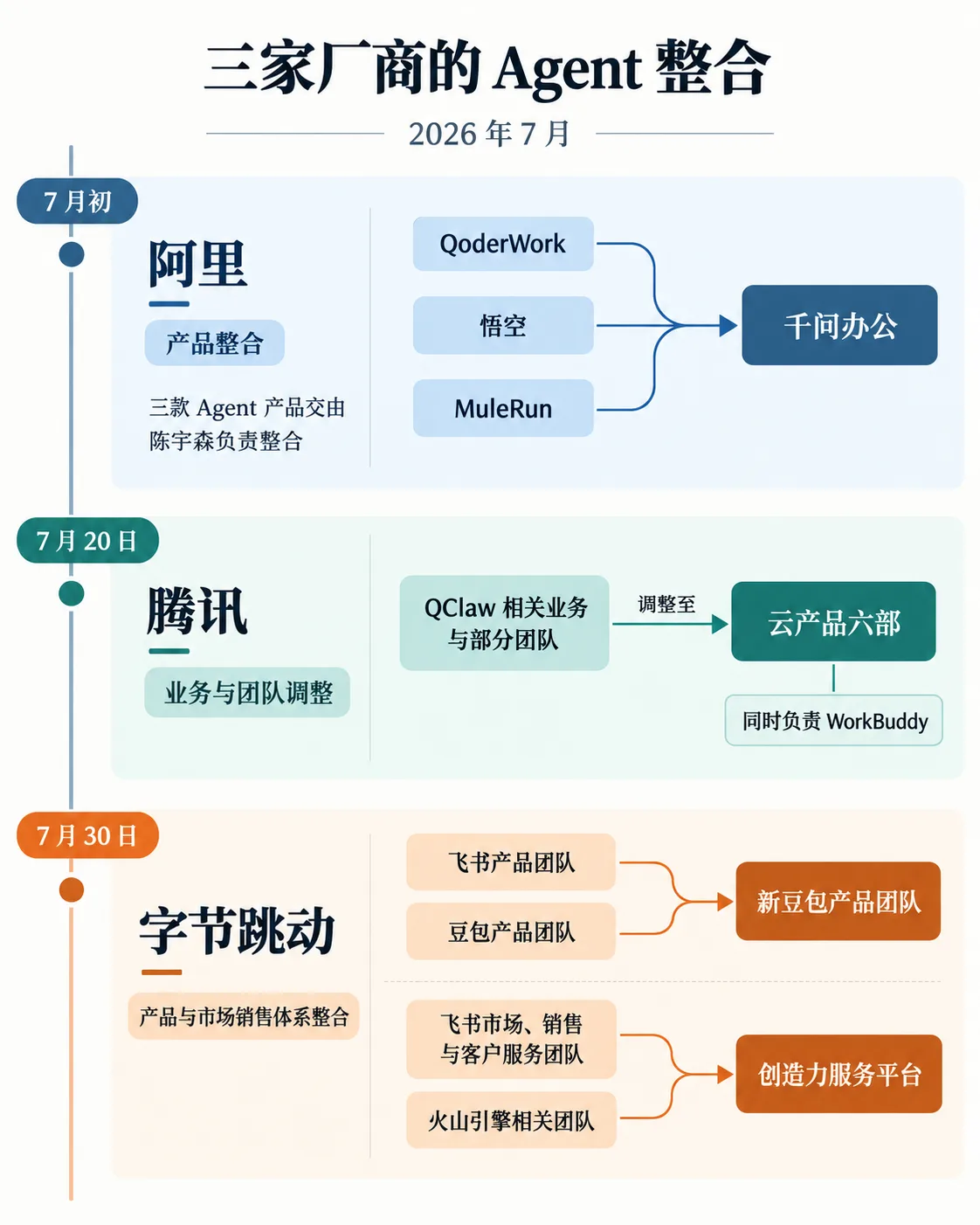
Technically, these moves are unsurprising. An agent that keeps completing tasks needs applications, models, and cloud infrastructure to work together. The teams responsible for each part must collaborate more closely as the product develops.
It is possible that each person will eventually have a personal AI agent. Opening your AI before starting work could become as ordinary as opening a search engine used to be. People would give it tasks; it would use tools, connect services, and carry out the subsequent steps.
That first point of contact is what these companies are competing for. They want to become the application people think of and open first, beginning with office work and extending to other tasks. It explains the push to combine models, applications, and cloud infrastructure. Competition for that entry point may become a new contest for attention and traffic in the AI era.
From office work to teaching
As general-purpose agents extend beyond office work, teaching is a natural neighboring setting. Lesson preparation, slide production, material organization, and data analysis already involve documents, searches, and digital tools. Capabilities developed for office work can often be applied to teaching without major changes.
Universities may be among the first places in education where general-purpose agents take hold. Students read, write, code, analyze data, and complete projects every day. Teachers work on teaching, research, and administration. Both groups can be relatively quick to try AI and willing to change how they complete tasks.
University students also have a particular importance to vendors: in a few years they will enter the workforce. Habits formed while studying, researching, and collaborating on projects may continue into their professional lives. Winning students on campus is not only about their usage during those few years; vendors hope they will keep using the same agent at work.
The resource demand behind tens of millions of students
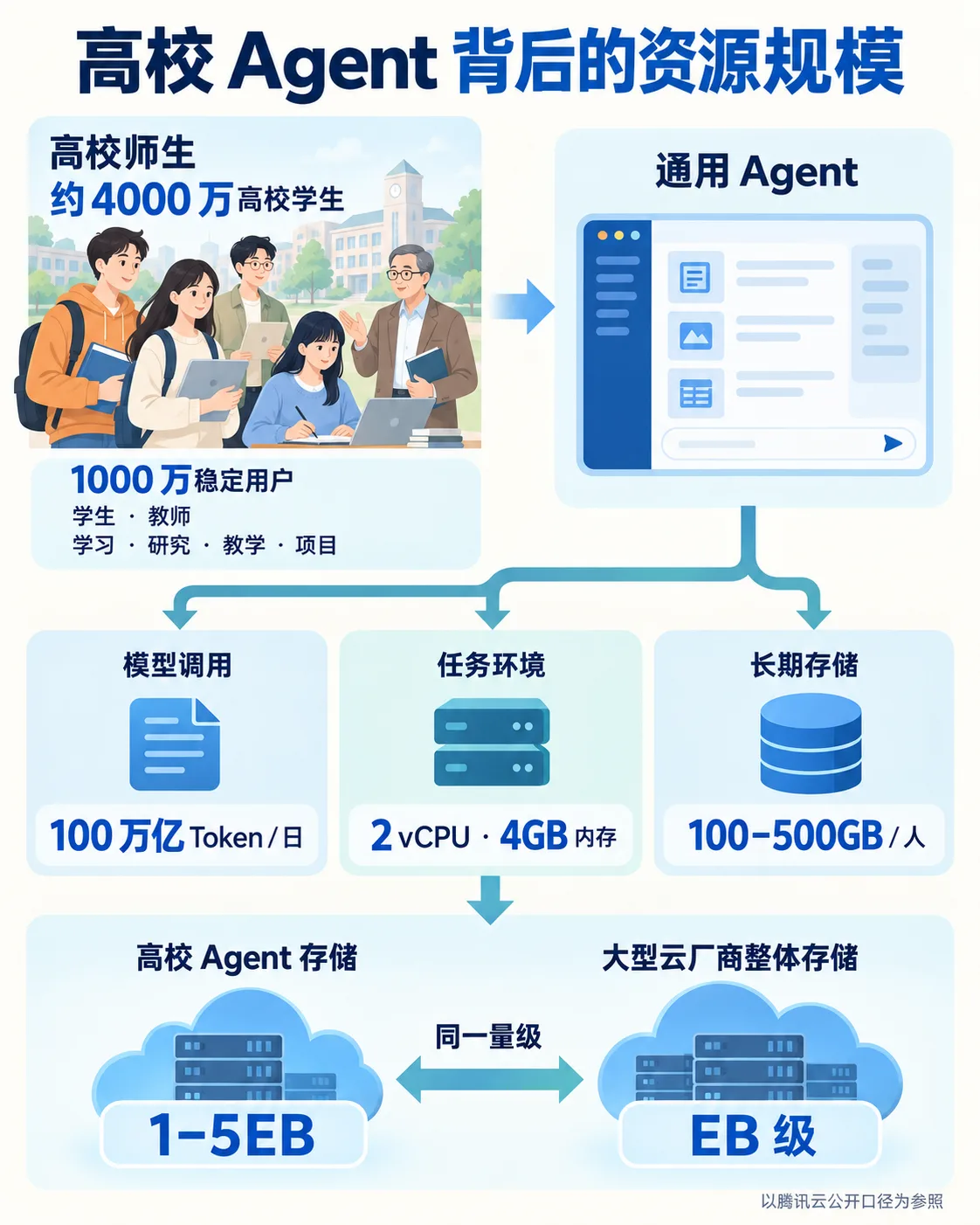
If agents become part of regular university work, model calls, task execution, and long-term storage will grow with the user base. With tens of millions of students in higher education, cloud providers have reason to take that market seriously.
The Chinese Ministry of Education reported about 43.84 million people in 2025 across ordinary undergraduate programs, vocational undergraduate programs, higher vocational colleges, and postgraduate study. Take roughly 40 million as a base, and suppose a quarter—10 million—become regular agent users.
There is not enough data to forecast this market precisely; the following is a rough estimate based on experience. I am a heavy AI user and use far more than 10 million tokens a day. Most people will not use as much as I do, so I take 10 million tokens per person per day as a middle-of-the-road assumption rather than an aggressive one.
Under those assumptions, 10 million users would generate 100 trillion tokens of calls per day—close to 70 percent of China’s reported average daily token volume in March 2026.
In my experience, a somewhat demanding office task may need an environment with about 2 vCPUs and 4 GB of memory. An agent accompanying me through four years of university might need 100–500 GB of long-term storage. Across 10 million users, that alone would amount to 1–5 exabytes. The storage requirement from these university users would be on the same order of magnitude as the total data-storage scale Tencent Cloud has publicly described.
These comparisons indicate the potential scale rather than a precise forecast. Even if only a quarter of students became regular users, the resulting demand for model calls and long-term storage would be a substantial market for cloud providers.
Three possible industry structures for AI in education
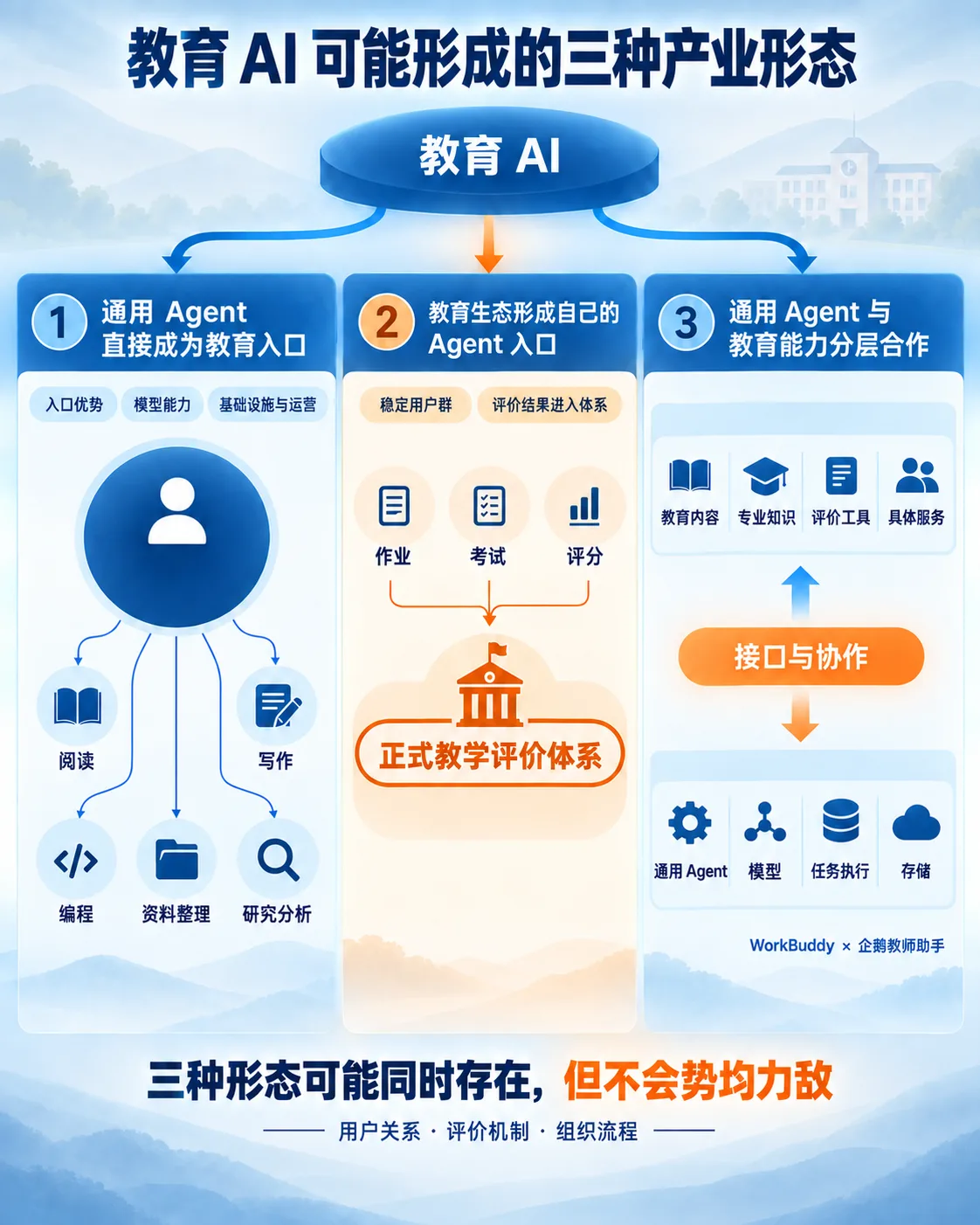
As general-purpose agents move from office work into teaching, learning, research, and projects, major technology companies enter an existing education-AI ecosystem. They bring models, infrastructure, and large-scale operations. Educational companies bring established products, content, and users; hardware makers cover learning devices and classroom equipment; new teams have grown around AI. When all of these players meet in one market, I see three possible forms.
First, a general-purpose agent might become the education entry point directly. It already has a place in office and everyday tasks, so users need not switch products to study or research. As models and tools improve, it may handle reading, writing, coding, organizing materials, and research analysis itself. With mature infrastructure and operations behind it, such an agent could absorb a great deal of educational demand.
Second, the education ecosystem might establish its own agent entry point. Education has a large, relatively stable user base and its own institutional systems. A general-purpose agent can technically set homework, arrange an exam, or grade a student. What is difficult is getting that grade accepted by a course or school and entered into a formal evaluation system. Only then does the agent’s output become part of education itself. China’s AI + Education Action Plan also names intelligent tools for educational evaluation. Whoever can connect to that evaluation system has a chance to build an independent entry point from within education.
Third, general-purpose agents and specialized education capabilities might cooperate in layers. The agent provides models, task execution, storage, and a user entry point. The education ecosystem supplies courses, subject expertise, evaluation tools, and services. Interfaces connect the two while each keeps what it does best. WorkBuddy and Penguin Teacher Assistant fit this possible path: WorkBuddy supplies a general agent entry point; Penguin Teacher Assistant attaches educational capabilities to it. The agent need not rebuild an understanding of the whole education system, and education products need not duplicate models and infrastructure.
The third option is tempting to treat as the answer. It seems sensible for both sides to specialize and cooperate rather than for either to do everything alone.
But a balanced arrangement is not necessarily the most likely one. Its durability depends on a stable boundary of capability between general-purpose agents and education products. If improving models allow general agents to absorb more educational work, the first form may gain ground. If evaluation systems, institutional processes, and user relationships support an independent entry point, the second can work too. The third becomes stable only if both sides retain capabilities the other cannot readily replace—and that boundary lasts.
It is too early to know which form will dominate. They are not two extremes with an automatically superior compromise in the middle. An industry does not settle on the most balanced-looking arrangement simply because it appears reasonable.
Sources:
[1] WorkBuddy, back-to-school benefits for new students.
[2] Xinhua, WorkBuddy’s back-to-school campaign, September 1, 2026.
[3] OpenClaw, “Introducing OpenClaw”; “Gateway Architecture”.
[4] Anthropic, “Scaling Managed Agents: Decoupling the Brain from the Hands”, April 8, 2026.
[5] 36Kr, report on the Feishu, Doubao, and Qwen organizational changes, August 6, 2026.
[6] Chinese Ministry of Education, 2025 national education statistics, July 6, 2026.
[7] Ministry of Industry and Information Technology, software and technology services briefing, March 2026.
[9] Chinese Ministry of Education and four other agencies, AI + Education Action Plan, April 2, 2026.
Translation: Codex prepared this English version from Biaoo’s published Chinese article. Biaoo developed the original estimates, analysis, and source selection.