A Skill That Changed How I Learn English
I thought I knew words like check, charge, and over. A teacher showed me how to look beyond their Chinese translations—and I turned that way of learning into a Skill.

In an English class recently, our teacher brought up some utterly ordinary words: check, charge, and over.
I had learned them long ago. At least, when I saw them, I thought I knew them.
But the teacher quickly showed me that what I called knowing was mostly remembering their common Chinese translations. Rather than adding more translations to the list, he asked a different kind of question:
How can
checkmean both to inspect and to control? How canchargerefer to a fee, an electrical charge, an accusation, or a forward rush? How doesovergo from “above” to “finished,” “beyond,” and “taking control”?If these meanings have nothing to do with one another, why does English use the same word for them?
He explained that many words cannot be learned simply by memorizing a list of Chinese equivalents. To understand them, you need to look past translation for an image at the center of their different uses: what scene, action, or relationship leads English speakers to choose the same word in such different contexts?
That was when I realized I had memorized these words without really understanding them.
I had learned translations, not words
Our teacher took check back to one of its earliest settings: chess.
When a player says
check, the opposing king is under attack. Its ordinary movement is interrupted and constrained. The player has to look at the board again, identify the threat, and decide what to do.
From this picture, he drew out two connected directions: control and verify.
One is to restrain something or stop it from continuing. Keep your temper in check does not mean “inspect your temper”; it means keep it under control. To check the spread is to halt something that is spreading.
The other is to pause and inspect or confirm. You check the schedule to verify it and check the answer to confirm it. A mark left after doing so is a check mark.
I used to store these uses separately. Inspection was one meaning, control another; verification and marking could simply be added to the list. My teacher showed me that they had not been arbitrarily stuffed into the same word. Back at the chessboard—where an action is interrupted and the situation has to be controlled and examined—the scattered Chinese translations began to connect.
I finally recognized the method I had been using: learning by rote. It turns an English word into a table of Chinese equivalents. Each new use gets another entry; when the word appears again, you try to match the situation to an answer you remember.
Memorization itself is not the problem. What you understand still needs to be remembered. The problem was that I had asked memory to do the work of understanding. I remembered how to translate a word in different sentences, but not why one word could carry those meanings.
My teacher’s approach was to take one step back from translation: find the word’s most basic picture, action, or relationship, then see how its uses develop from there. Chinese equivalents remain useful, but they should be where understanding lands—not where it begins and ends.
Rote learning told me what a word could be translated as. Its central image showed me why it could mean those things.
A better teacher was now within reach
After walking us through the words, our teacher said something quite direct:
Now that we have AI, this needn’t be a problem. When you don’t understand something, ask AI how to understand it. Keep talking until it actually makes sense to you.
What used to be scarce in this kind of learning was not a dictionary or a set of example sentences. It was someone willing to explain a point of confusion again and again. If one picture did not work, they could try another. If the difference between two words remained hazy, they could put both in the same scene. If an explanation failed to cover a new use, they could revise it. That required a teacher who was present, capable, and able to spend enough time on one student’s question.
AI changes that condition. It is available whenever a question arises, with a range of knowledge, examples, and angles of explanation that no one person could cover at once. A question need not wait until the next lesson, and it need not be abandoned because it seems too small, obscure, or hard to phrase. The conversation can begin as soon as the confusion appears.
The starting point for learning changes, too. It need not always be a course someone else has laid out. A question that comes up while reading a sentence, a distinction between two concepts that you cannot quite explain, or a sudden “why?” can become a path of inquiry. Curiosity need not be a detour from the plan; it can determine what to learn next.
But asking AI a question is not the same as learning with it.
“What does check mean?” asks for an answer. “How should I understand check?” asks AI to organize an explanation around my confusion: where to start, what picture to hold onto, and how the uses connect. If an answer does not make sense, I can keep asking. If one account is too abstract, I can ask for another image or a different set of examples. The conversation ends not when an answer appears, but when understanding begins to take shape.
With AI, a genuine question can start a learning journey at any time. The skill we need is learning how to work through that question with AI until we understand it.
I made the teacher’s method into a Skill
I did not just save my teacher’s explanation of check. I extracted the method behind it and made a Skill called word-meaning-lens.
The point was not to preserve answers for a few words. It was to preserve a way of explaining them: move past the surface translations to find a semantic structure that connects important uses; resist forcing every use into one tidy core merely for the sake of tidiness; and use concrete pictures, actions, and relationships so that a meaning can be felt as well as defined.
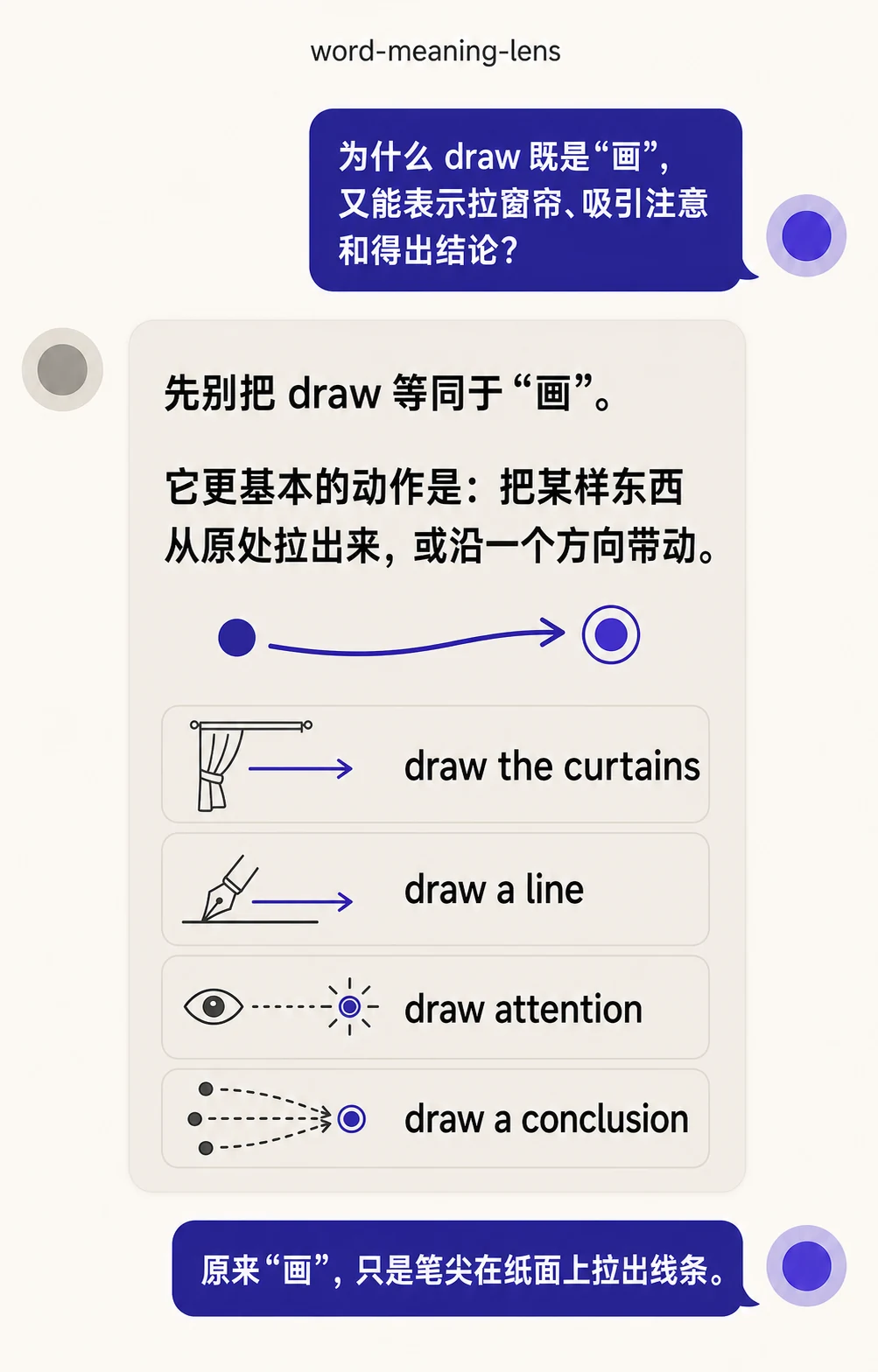
What I wanted to keep was not the answer to one word, but this lens for seeing how words mean.
Translation: Codex prepared this English version from Biaoo’s published Chinese article. Biaoo wrote the original argument and selected the example.